
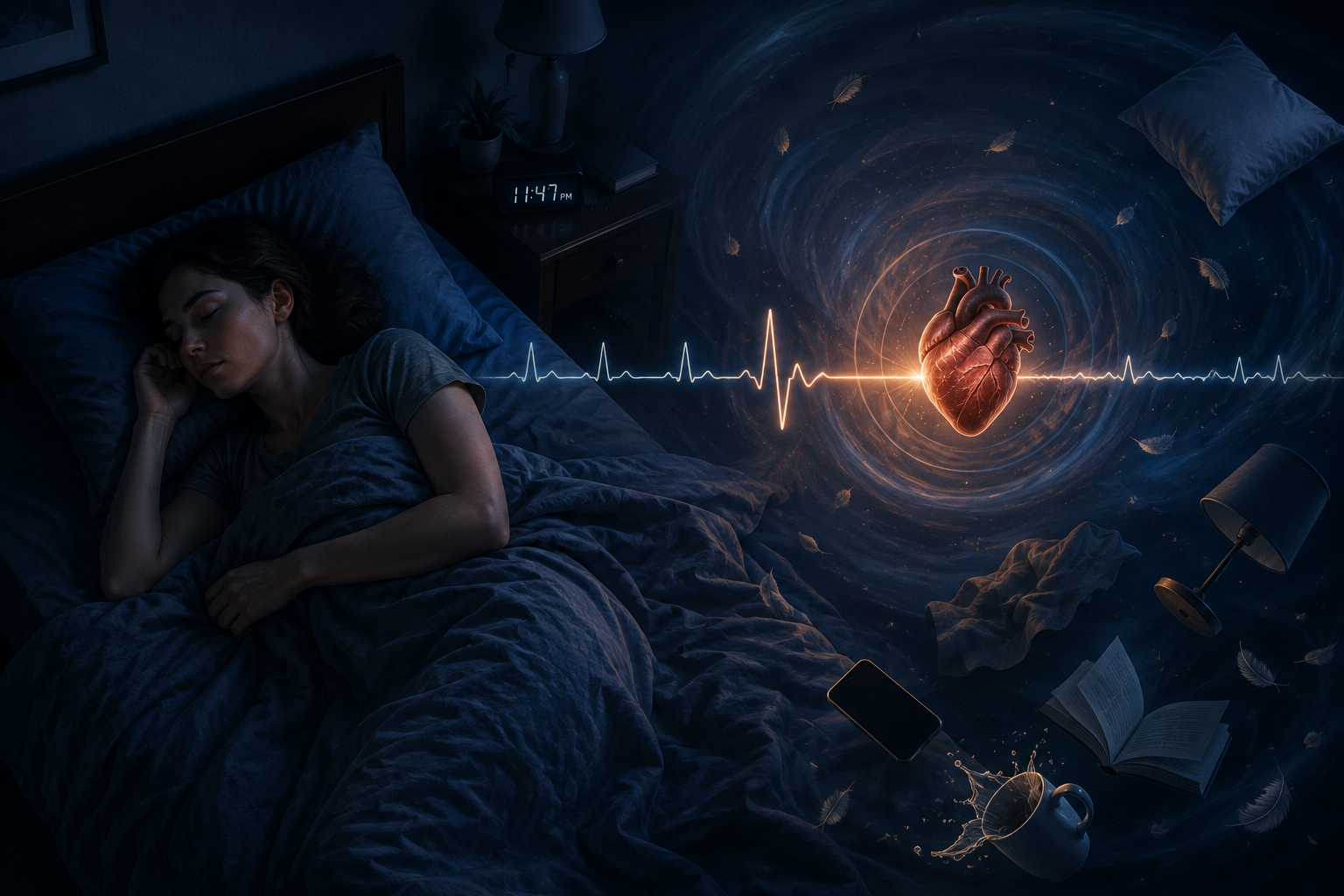
You finally lie down.
Your body starts to relax. Your breathing slows. You can feel yourself drifting toward sleep.
And then suddenly—your heart does something strange.
A skip. A flutter. A sudden thump that feels stronger than normal.
It grabs your attention immediately.
You might sit up. You might take a deeper breath. You might even feel a wave of alertness rush through your body.
And the thought appears quickly:
“Why does my heart skip when trying to fall asleep?”
If you’ve felt this, you’re not alone.
And just as important—this experience is far more common than you think.
If this is happening to you at night, you don’t need more information — you need something that helps your body settle in the moment.
I created a free 5-minute emergency sleep reset you can use when your body feels wired, panicky, or unable to shut off.
👉 Start the free reset here:
Free 5-Minute Emergency Sleep Reset
Table of Contents
- This Happens to Many People at Night
- This Is Usually a Nervous System Response (Not a Heart Problem)
- What It Actually Feels Like
- Why It Happens When You’re Trying to Fall Asleep
- Why It Keeps Happening (The Loop)
- How This Connects to Sleep Anxiety
- Other Sensations That Often Happen Alongside This
- This Is Not Dangerous — It’s a Pattern
- A Gentle Next Step
- Frequently Asked Questions
This Happens to Many People at Night
Heart sensations like skipping, fluttering, or brief pounding are especially common when you’re lying down at night.
During the day, your attention is focused outward—on tasks, conversations, movement.
At night, everything changes.
The environment becomes quiet. Your body becomes still. Your awareness turns inward.
That’s when you begin to notice things you normally wouldn’t.
And your heartbeat is one of the most noticeable sensations in your body.
So when your heart skips when trying to fall asleep, it can feel intense—even alarming.
But the sensation itself is not a sign that something is wrong.
This Is Usually a Nervous System Response (Not a Heart Problem)
Even though it feels like your heart is the issue, what you’re experiencing is most often related to your nervous system.
Your heart and your nervous system are closely connected.
When your nervous system becomes slightly activated—even briefly—it can change the rhythm and sensation of your heartbeat.
This can show up as:
- A skipped beat feeling
- A flutter in your chest
- A sudden strong “thump”
- A brief racing sensation
These shifts are often harmless.
They’re simply your body responding to a moment of activation.
And at night, that activation is easier to notice.
What It Actually Feels Like
People describe this experience in very similar ways.
You might notice:
- Your heart feels like it skips or pauses for a second
- A quick flutter or vibration in your chest
- A sudden stronger heartbeat after the “skip”
- A brief sense of your heart racing
- An adrenaline surge when falling asleep that follows the sensation
And often, it’s not just physical.
There’s an emotional reaction too:
- A spike of alertness
- A moment of fear or concern
- A shift from relaxed to fully awake
This combination can make the experience feel much more intense than it actually is.
Why It Happens When You’re Trying to Fall Asleep
There are two main reasons this shows up at night.
1. Increased Awareness
When you lie down, your awareness turns inward.
You begin to notice your breathing, your body, and your heartbeat.
Small variations that you would ignore during the day become very noticeable.
2. Nervous System Activation During Transition
Falling asleep requires your nervous system to shift from an alert state to a calm one.
Sometimes, that shift isn’t perfectly smooth.
Your system may briefly activate—just enough to create a noticeable change in your heartbeat.
This is especially true if your body has been under stress, even if you don’t feel anxious in the moment.
If this is happening to you at night, you don’t need more information — you need something that helps your body settle in the moment.
I created a free 5-minute emergency sleep reset you can use when your body feels wired, panicky, or unable to shut off.
👉 Start the free reset here:
Free 5-Minute Emergency Sleep Reset
Why It Keeps Happening (The Loop)
For many people, this doesn’t just happen once.
It starts repeating.
And that’s because of a very natural loop:
Focus → awareness → amplification → more fear
Here’s how it works:
- You notice your heart skip
- You focus on your heartbeat
- The sensation feels stronger
- Your nervous system becomes more alert
- Your heart responds again
Nothing is “wrong.”
Your system is simply responding to attention and activation.
The more closely you monitor it, the more noticeable it becomes.
How This Connects to Sleep Anxiety
If your heart skips when trying to fall asleep, it’s often part of a larger pattern.
This pattern is sometimes called sleep anxiety.
It can include:
- panic when falling asleep
- Adrenaline surges
- Sudden alertness at night
- Physical sensations that feel unusual or intense
These symptoms are connected.
They’re often different expressions of the same nighttime nervous system activation pattern explained in this sleep anxiety help guide.
They all come from the same place—your nervous system staying slightly active when it’s trying to settle.
If you want to see how these symptoms fit together, this guide explains the bigger picture of sleep anxiety symptoms.
Understanding the pattern often reduces a lot of the fear around it.
Other Sensations That Often Happen Alongside This
It’s also common for this to show up with other nighttime sensations.
Some people also experience a sudden jolt awake right as they begin falling asleep.
You might also notice:
- heart racing when trying to sleep
- Sudden body awareness
- Strange physical sensations
- A sense that your body feels “off”
If that last one resonates, this article goes deeper into it:
Why Does My Body Feel Weird When I Try to Sleep?
These are all variations of the same nervous system pattern.
This Is Not Dangerous — It’s a Pattern
This is the most important takeaway.
When your heart skips when trying to fall asleep, it does not mean something is wrong with your heart.
It means your nervous system is active during a sensitive transition.
The sensation is real.
But it is not harmful.
And because it’s a learned pattern, it can change.
A Gentle Next Step
If this is happening to you at night, you don’t need more information — you need something that helps your body settle in the moment.
I created a free 5-minute emergency sleep reset you can use when your body feels wired, panicky, or unable to shut off.
👉 Start the free reset here:
Free 5-Minute Emergency Sleep Reset
Frequently Asked Questions
This usually happens because your nervous system briefly activates as you transition into sleep. That activation can change how your heartbeat feels, creating a skipping or fluttering sensation.
No. While it can feel alarming, this sensation is typically harmless. It is a common nervous system response and not a sign that something is wrong with your heart.
They can feel like palpitations, but they are often linked to nervous system activity rather than a heart issue. Many people experience this during periods of stress or heightened awareness.
At night, your environment is quiet and your attention turns inward. This makes normal body sensations feel stronger and more noticeable.
Yes. Anxiety increases nervous system activation, which can affect how your heartbeat feels. Even subtle anxiety can make these sensations more noticeable.
Yes. As your nervous system learns to settle more fully at night, these sensations often become less frequent and less intense over time.
Add your first comment to this post