
SLEEP ANXIETY RESOURCE CENTER
Sleep Anxiety Help: Why Your Body Won’t Shut Off at Night
If you’re exhausted but your body becomes alert the moment you try to sleep, there may be more happening than simple insomnia. Learn why nighttime anxiety, adrenaline surges, racing heart sensations, body jolts, and sudden fear can become connected—and what can help your nervous system settle again.
Understand what’s happening. Reduce the fear. Help your body relearn safety at night.
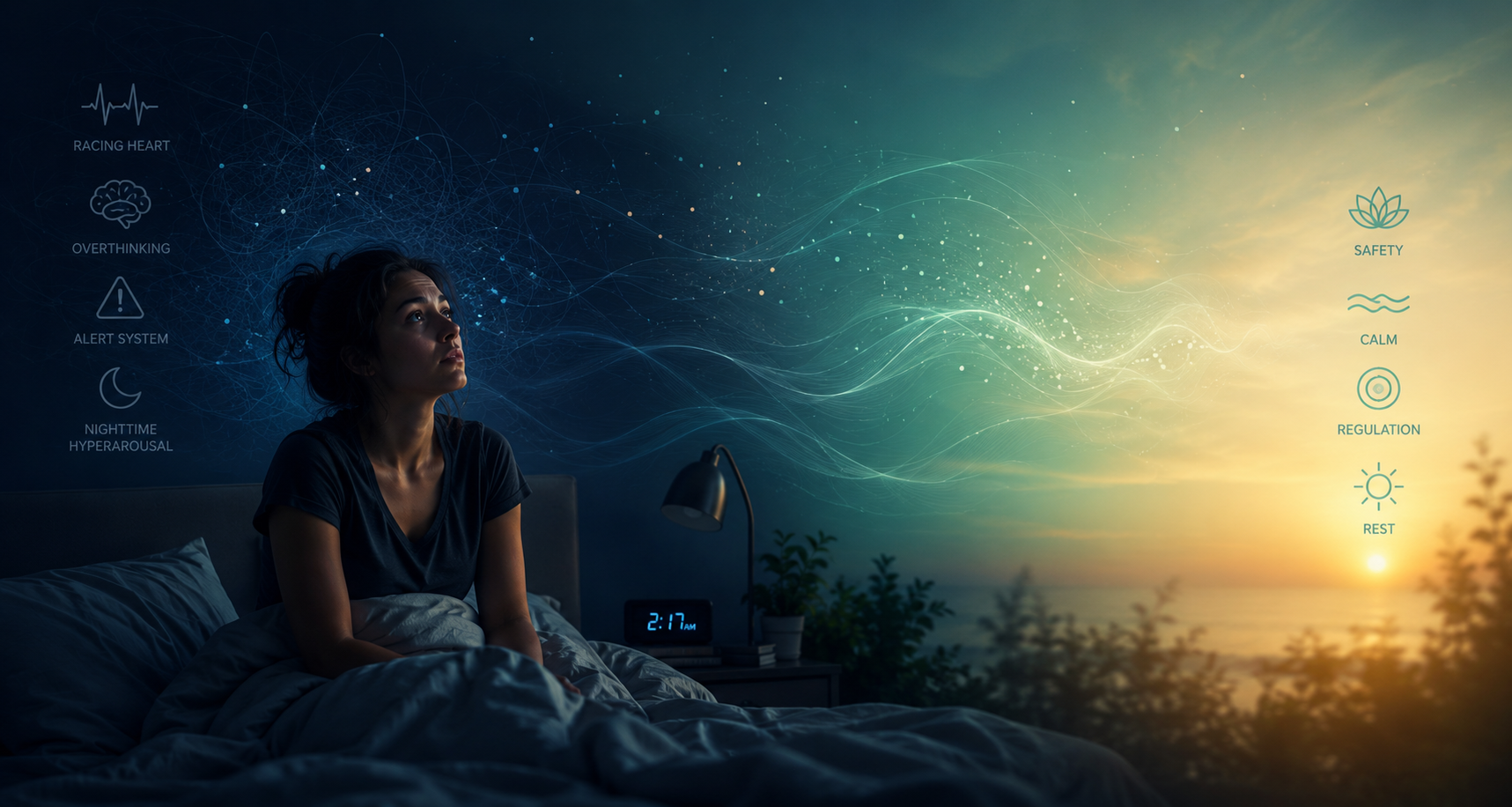
You’re exhausted.
Your body feels drained. Your eyes are heavy. You want sleep more than anything.
And then the moment you finally lie down… your system turns back on.
Your heart starts racing.
You feel an adrenaline surge when falling asleep.
Your body jolts awake before sleep fully takes over.
You become hyper-aware of your breathing, your heartbeat, your chest, your body.
Sometimes it feels like panic.
Sometimes it feels like impending doom.
Sometimes it feels impossible to explain to anyone who hasn’t experienced it.
You may even find yourself wondering:
“Why does this only happen at night?”
“Why can’t my body just relax?”
“Am I stuck like this forever?”
If you’re searching for real sleep anxiety help, the first thing to understand is this:
Your body is not broken.
And this is usually not a willpower problem.
What you’re experiencing is often a conditioned nervous system response.
Your body learned to stay alert at night.
And once that pattern forms, bedtime itself can begin triggering activation automatically.
That’s why so many people feel completely functional during the day… yet experience intense physical anxiety symptoms the moment sleep gets close.
For some people, the fear becomes specifically attached to the act of falling asleep itself. Read more here: Fear of Falling Asleep.
This page will help you understand what’s happening, why traditional sleep advice often fails, and how the nervous system can gradually relearn safety at night.
You’ll understand why this happens, what your nervous system may be responding to, and what can actually help.
- Why sleep anxiety happens
- Why your body becomes activated at night
- Why symptoms feel physical
- What actually helps calm the nervous system
- How recovery gradually becomes possible
- What Sleep Anxiety Actually Feels Like
- Why Your Nervous System Stays Alert at Night
- Why Symptoms Feel Worse at Night
- Why Traditional Sleep Advice Often Fails
- Related Sleep Anxiety Symptoms and Patterns
- What Actually Helps the Nervous System Settle
- A Gentle Place to Start
- When Short-Term Relief Isn’t Enough
- Frequently Asked Questions
- You Are Not Broken
- More Sleep Anxiety Articles
What Sleep Anxiety Actually Feels Like
Sleep anxiety is often misunderstood because it doesn’t always feel like “anxiety” in the traditional sense.
For many people, it feels intensely physical.
The body reacts before the mind even has time to think.
Sleep anxiety can show up as:
- Racing heart at night
- Sudden adrenaline surges before sleep
- Jolting awake while drifting off
- Waking suddenly with panic or dread
- Feeling “wired but exhausted”
- Chest tightness or body tension
- Hyper-awareness of bodily sensations
- Nighttime panic attacks
- Feeling like your body won’t shut off at night
Some people describe it as feeling trapped between exhaustion and alertness.
Others describe it as if their body “refuses” to let them fall asleep.
And many people become frightened because the symptoms feel so intense and physical.
But the intensity of the sensation does not mean danger.
It often means the nervous system is stuck in protection mode.
Why Your Nervous System Stays Alert at Night
The nervous system is designed to protect you.
Its job is to detect danger, monitor safety, and keep you alive.
But sometimes that system learns patterns that continue long after the original stress has passed.
And night can become one of those patterns.
Over time, the nervous system may begin associating nighttime with:
- Loss of control
- Vulnerability
- Isolation
- Hyper-awareness
- Fear of symptoms themselves
Once that association forms, bedtime becomes emotionally loaded.
Not consciously.
Physiologically.
This is why many people experience a sudden adrenaline surge when falling asleep even when they are mentally calm.
The body reacts automatically.
Like a smoke alarm that became too sensitive.Not because the house is burning down.
Because the system learned to stay alert.
Why Symptoms Feel Worse at Night
During the day, your attention is constantly occupied.
Movement.
Noise.
Tasks.
Conversations.
Distractions.
But nighttime removes all of that.
The environment quiets down.
The body becomes still.
And suddenly, internal sensations become much louder.
This is why people often notice:
- Heart racing when lying down
- Body sensations when drifting off
- Breathing awareness
- Panic waves during sleep onset
- Jolting awake before sleep fully begins
The body is not creating danger.
You’re simply becoming more aware of sensations that the nervous system is amplifying.
And once fear enters the loop, the body becomes even more alert.
Why Traditional Sleep Advice Often Fails
This is one of the most frustrating parts for people dealing with nervous system sleep anxiety.
You’ve probably already tried:
- Sleep hygiene routines
- Melatonin
- Meditation apps
- Breathing exercises
- Relaxation videos
- White noise
- “Just calm down” advice
And sometimes those things help temporarily.
But many people notice the symptoms keep returning.
Why?
Because most sleep advice focuses on sleep itself.
But this pattern is often about nervous system protection.
If the body still believes nighttime requires vigilance, then trying harder to sleep can accidentally increase pressure and monitoring.
And monitoring keeps the nervous system activated.
This is why many people experience a frustrating cycle:
Trying harder → increased awareness → more activation → less sleep
The goal is not forcing sleep.
The goal is helping the body feel safe enough to stop protecting.
Related Sleep Anxiety Symptoms and Patterns
Sleep anxiety rarely appears in only one form.
Many people experience multiple connected symptoms that all come from the same nervous system pattern.
You may recognize yourself in some of these experiences:
These symptoms often overlap because they share the same root pattern:
What Actually Helps the Nervous System Settle
Real improvement usually begins when people stop treating this as a battle.
The body does not calm through force.
It calms through safety.
That means the process often involves:
- Reducing fear around symptoms
- Stopping constant monitoring
- Allowing sensations instead of fighting them
- Teaching the body that nighttime is safe again
- Repeated experiences of regulation
This is why nervous system approaches often feel different from generic sleep advice.
The goal is not knocking yourself out.
The goal is helping the body stop acting like it’s under threat.
And importantly:
This pattern can change.
The nervous system learns through repetition.
Which means learned activation patterns can also be unlearned.
A Gentle Place to Start
If your body feels constantly alert at night, you do not need more pressure.
You need a different experience.
That’s why I created a short guided audio specifically for people dealing with nighttime hyperarousal, adrenaline surges, racing heart symptoms, and sleep anxiety patterns.
It’s designed to help the nervous system gradually shift out of protection mode—without forcing sleep or fighting the body.
Free 5-Minute Emergency Sleep Reset
Many people use it during moments of nighttime activation when their body feels stuck in alert mode.
When Short-Term Relief Isn’t Enough
For some people, nervous system activation has been happening for months or even years.
The pattern becomes deeply conditioned.
The body begins expecting activation at bedtime.
That’s where deeper retraining work can help.
Nervous System Shutdown for Sleep™
This program was created specifically for people whose bodies stay physically activated at night.
It focuses on:
- Nervous system down-regulation
- Reducing nighttime hyperarousal
- Calming conditioned sleep fear
- Helping the body relearn shutdown and rest
Not through hype.
Not through forcing relaxation.
But through gradual nervous system retraining.
Frequently Asked Questions
Sleep anxiety help usually involves understanding why the nervous system becomes activated at night and learning how to reduce that activation safely and gradually. For many people, the issue is not simply insomnia or overthinking—it’s a body that has learned to stay alert during the sleep transition.
This often happens because the nervous system associates nighttime with vulnerability, loss of control, or previous distressing experiences. As the body begins transitioning into sleep, it can trigger protective responses like adrenaline surges, racing heart sensations, or sudden alertness.
At night, external distractions decrease and internal awareness increases. This can make normal body sensations feel amplified. If the nervous system is already activated, your heartbeat may suddenly feel louder, faster, or more noticeable.
Adrenaline surges during sleep onset are often connected to nervous system hyperarousal. As the body relaxes, the brain may misinterpret the transition as unsafe and release stress hormones to keep you alert.
Jolting awake before sleep is commonly connected to hypervigilance and nervous system activation. The body struggles to fully let go into sleep because it remains partially alert and monitoring.
Yes. Anxiety and nervous system activation can create very real physical sensations including racing heart, chest tightness, adrenaline rushes, body jolts, tingling, breath awareness, and nighttime panic symptoms.
This “wired but tired” state often happens when physical exhaustion and nervous system activation exist at the same time. The body is tired, but the protective system has not fully powered down yet.
In many cases, yes. Nervous system patterns are learned through repetition, which means they can also be retrained through repeated experiences of safety, regulation, and reduced fear around nighttime symptoms.
You Are Not Broken
If your body panics at night, it does not mean you are weak.
It does not mean you are “crazy.”
And it does not mean your body is permanently damaged.
Very often, it means your nervous system learned a protection pattern that no longer serves you.
If sleep itself has started to feel unsafe or frightening, this article may help: Fear of Falling Asleep.
And learned patterns can change.
Slowly.
Gently.
Safely.
The goal is not forcing your body into sleep.
The goal is helping your system finally realize it no longer has to stay on guard all night.
That process takes patience.
But it is possible.
More Sleep Anxiety Articles
- Why Does My Heart Feel Like It Skips When I’m Trying to Fall Asleep?
- Body Won’t Let Me Sleep: Why It Feels Like Your System Is Fighting Rest
- Why Anxiety Disappears in the Morning
- How to Calm Your Nervous System Before Sleep
- Body Won’t Relax to Fall Asleep
- Why You Wake Up Already Exhausted
- EFT Tapping for Nighttime Anxiety
- Why You Wake Up With a Racing Heart at Night
- Why Loneliness Feels Worse at Night
- What Causes Insomnia?