
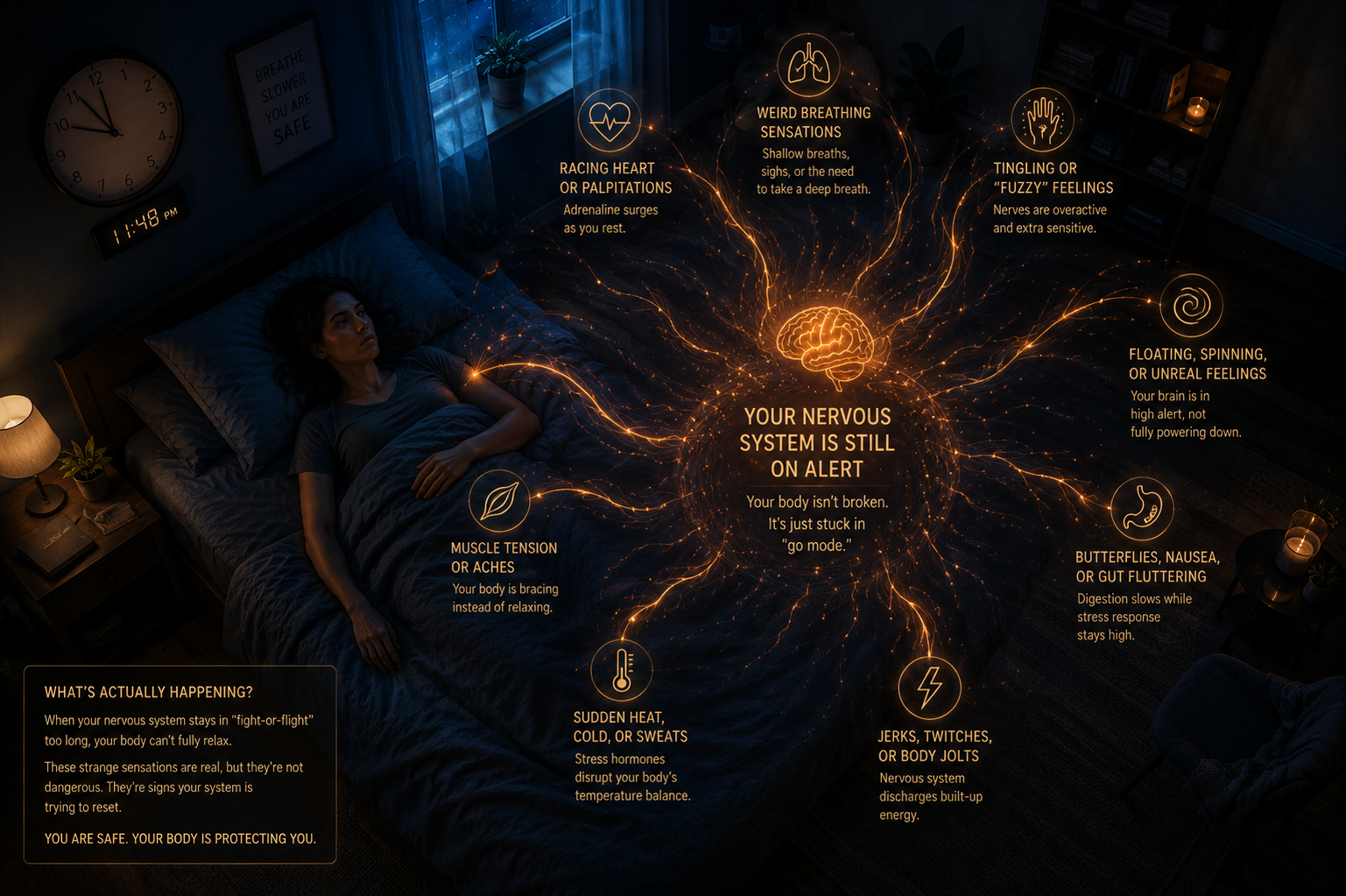
You finally lie down.
The lights are off. Your body is tired. You’re ready to sleep.
And then… something feels off.
As you begin to drift, your body starts doing things you don’t expect.
There’s a strange sensation in your chest… or your arms… or your whole body.
Maybe it’s tingling. Maybe it feels like you’re floating. Maybe it’s a sudden drop or shift that makes you open your eyes again.
And the thought comes quickly:
“Why does my body feel weird when trying to sleep?”
If you’ve been experiencing this, you’re not alone.
And more importantly—this is not a sign that something is wrong with your body.
If this is happening to you at night, you don’t need more information — you need something that helps your body settle in the moment.
I created a free 5-minute emergency sleep reset you can use when your body feels wired, panicky, or unable to shut off.
👉 Start the free reset here:
Free 5-Minute Emergency Sleep Reset
Table of Contents
- This Is Very Common (Even If It Feels Unusual)
- What’s Actually Happening in Your Body
- Common Sensations People Experience
- Why This Happens Right Before Sleep
- Why It Keeps Happening
- How This Connects to Sleep Anxiety
- A Deeper Layer: Regulation and Energy Patterns
- This Is Not Dangerous — It’s a Pattern
- A Gentle Next Step
- Frequently Asked Questions
- Related Sleep Anxiety Articles
This Is Very Common (Even If It Feels Unusual)
Strange sensations at night are incredibly common, especially when your body is transitioning into sleep.
Many people experience periods where their body feels unfamiliar, uncomfortable, or overly noticeable at night.
It can feel confusing because:
- There’s no clear cause
- You felt fine just moments before
- The sensations feel physical, not mental
But these sensations are not random.
They are part of how your nervous system behaves when it hasn’t fully settled yet.
What’s Actually Happening in Your Body
When your body feels weird when trying to sleep, it’s not because something is wrong.
It’s because your nervous system is still active during a moment when it’s supposed to power down.
As you fall asleep, your body shifts into a different state:
- Your muscles relax
- Your breathing becomes automatic
- Your awareness fades
If your system is calm, this transition feels smooth.
If your system is slightly alert, the transition can feel strange.
Your brain briefly checks what’s happening.
And that check creates sensations.
Those sensations are what you’re feeling.
Common Sensations People Experience
Even though it may feel unique to you, most people describe very similar experiences.
You might notice:
- Tingling when trying to sleep in your hands, chest, or body
- A floating or disconnected feeling
- A falling sensation when trying to sleep
- An adrenaline surge when falling asleep
- Heart racing when trying to fall asleep
- A sudden return to alertness just as you drift off
- Moments of panic when drifting off to sleep
These sensations can feel intense.
But they are all variations of the same underlying pattern.
Your nervous system is still slightly activated.
If this is happening to you at night, you don’t need more information — you need something that helps your body settle in the moment.
I created a free 5-minute emergency sleep reset you can use when your body feels wired, panicky, or unable to shut off.
👉 Start the free reset here:
Free 5-Minute Emergency Sleep Reset
Why This Happens Right Before Sleep
Falling asleep is one of the most sensitive transitions your body goes through.
You’re moving from control into letting go.
Your breathing becomes automatic.
Your awareness fades.
Your body takes over.
For a calm system, this feels natural.
For a system that is even slightly alert, it can feel unfamiliar.
So your body performs a quick “safety check.”
That check can create:
- Strange sensations
- A sudden shift in awareness
- A brief activation of your system
It’s not a problem.
It’s a protective reflex.
Why It Keeps Happening
At first, this might happen occasionally.
But then it can start repeating.
This is where a simple loop forms:
Awareness → monitoring → increased sensation → more alertness
Here’s what that looks like:
- You notice the sensation
- You start paying closer attention to your body
- The sensation feels stronger
- Your nervous system becomes more alert
- The pattern repeats
This doesn’t mean you’re causing it.
It means your system has learned a pattern.
And once a pattern is learned, your body repeats it automatically.
How This Connects to Sleep Anxiety
If your body feels weird when trying to sleep, it’s often part of a broader pattern known as sleep anxiety.
This can include:
- Sudden alertness at night
- Adrenaline surges
- Racing heart
- Jolting awake sensations
These are all connected.
They come from the same place:
A nervous system that hasn’t fully settled at night.
If you want a deeper understanding of how these symptoms connect, you can read:
Sleep Anxiety Symptoms: Why Your Body Panics at Night (And How to Stop It)
This helps put the experience into a bigger, more understandable picture.
A Deeper Layer: Regulation and Energy Patterns
For some people, these sensations aren’t just about sleep.
They reflect a deeper pattern in how the body regulates stress, tension, and energy.
When the system stays slightly activated, it often shows up most clearly at night—when everything else becomes quiet.
This is why some people explore approaches like EFT tapping or energy balancing practices to help their system settle.
If you’re curious about that, you can explore this here:
Free 5-Minute EFT Tapping Reset for Stress & Anxiety
These approaches focus on helping the body feel safe again—without force.
This Is Not Dangerous — It’s a Pattern
This is the most important shift you can make.
When your body feels weird when trying to sleep, it does not mean something is wrong.
It means your nervous system is active during a moment of transition.
The sensations are real.
But they are not harmful.
And because this is a learned pattern, it can change.
A Gentle Next Step
If this is happening to you at night, you don’t need more information — you need something that helps your body settle in the moment.
I created a free 5-minute emergency sleep reset you can use when your body feels wired, panicky, or unable to shut off.
👉 Start the free reset here:
Free 5-Minute Emergency Sleep Reset
Frequently Asked Questions
This usually happens because your nervous system is still slightly active during the transition into sleep. As your body relaxes, your system may create sensations that feel unfamiliar but are not harmful.
It can feel very physical, but it’s usually driven by your nervous system. Anxiety increases sensitivity, which makes these sensations more noticeable.
As your body relaxes, changes in muscle tension and awareness can create tingling or floating sensations. These are normal during sleep onset when the nervous system is active.
At night, there are fewer distractions and your attention turns inward. This makes body sensations feel stronger and more noticeable.
Yes. As your nervous system learns that it’s safe to relax at night, these sensations typically decrease and become much less noticeable. Many people experience major improvement as the nervous system learns that sleep is safe again.
No. Even though it feels intense, these sensations are not dangerous. They are a common nervous system response and not a sign of something serious.
Add your first comment to this post