
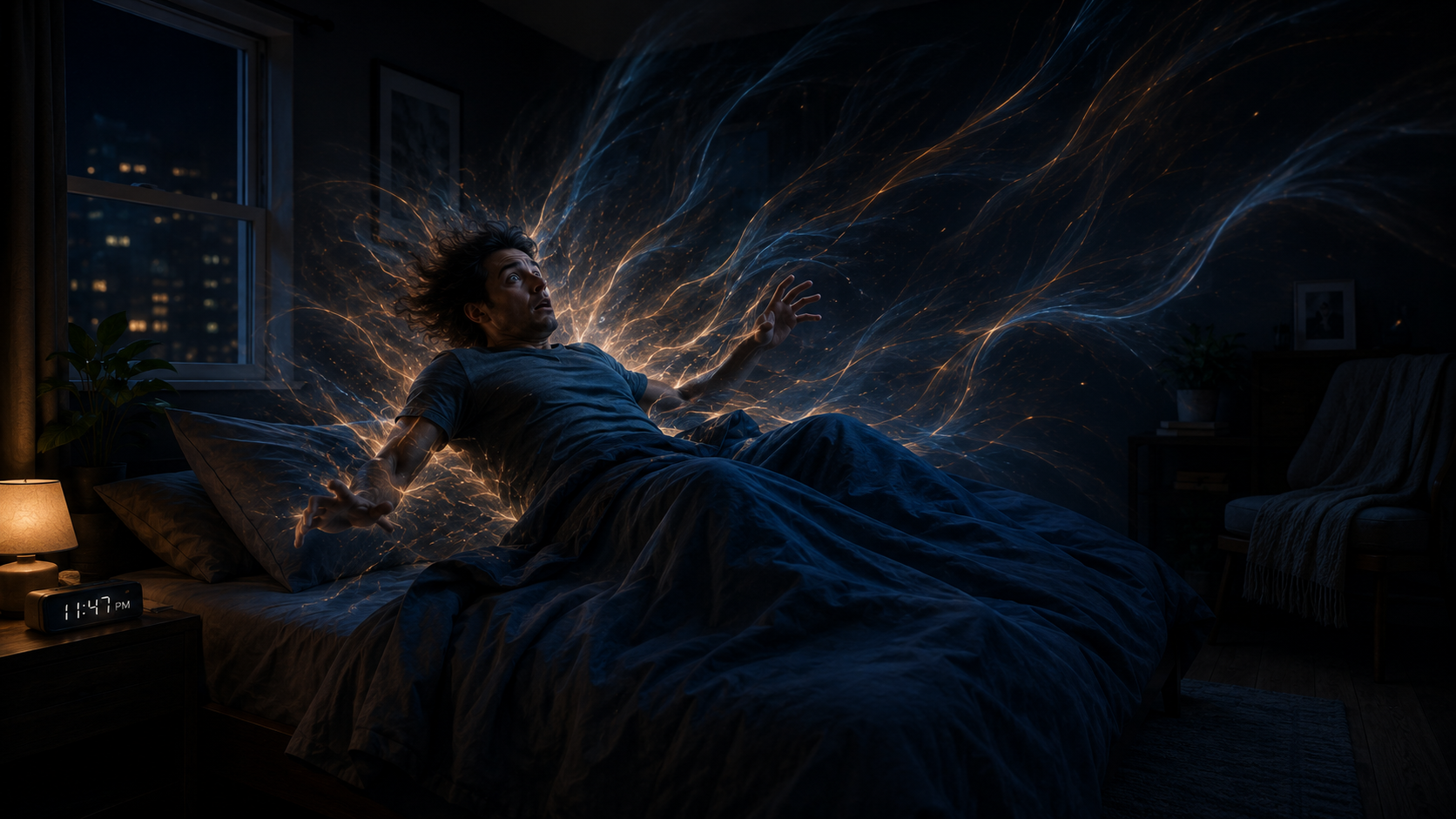
You’re just about to fall asleep.
Your body is finally relaxing. Your thoughts are slowing down. You feel yourself drifting…
And then suddenly—your body jolts.
Your eyes open. Your heart is racing. There’s a surge of alertness that feels like it came out of nowhere.
For a moment, it can feel alarming.
If you’ve been experiencing jolting awake from sleep anxiety, this exact pattern is likely very familiar to you.
And while it feels intense, what’s happening here is much more common—and much less dangerous—than it seems.
If this is happening to you at night, you don’t need more information — you need something that helps your body settle in the moment.
I created a free 5-minute emergency sleep reset you can use when your body feels wired, panicky, or unable to shut off.
👉 Start the free reset here:
Free 5-Minute Emergency Sleep Reset
Table of Contents
- This Happens to More People Than You Think
- What’s Actually Happening in Your Body
- What It Feels Like
- Why This Happens Right at Sleep Onset
- Why Trying to Force Sleep Makes It Worse
- When These Nighttime Symptoms Become a Pattern
- This Is a Pattern — Not a Problem
- A Deeper Layer to Be Aware Of
- What Helps Your Body Settle
- A Gentle Reminder
- A Gentle Next Step
- Frequently Asked Questions
- Related Sleep Anxiety Symptoms
This Happens to More People Than You Think
Waking up suddenly right as you fall asleep is one of the most common nighttime anxiety experiences.
Many people go through periods where their body seems unable to fully “let go” into sleep.
It can feel confusing because:
- You were calm just moments before
- There was no obvious trigger
- The reaction feels physical, not mental
But this doesn’t mean something is wrong with you.
It means your nervous system is still slightly activated when it’s trying to power down.
What’s Actually Happening in Your Body
When you experience jolting awake from sleep anxiety, it’s not your thoughts causing the problem.
And it’s not your heart malfunctioning.
It’s your nervous system staying “on” when it should be settling.
Your body is designed to shift from alertness into rest gradually.
But when your system is sensitive or overstimulated, that transition becomes unstable.
Instead of smoothly drifting into sleep, your body briefly activates.
That activation is what you feel as the jolt.
What It Feels Like
People describe this experience in very similar ways.
You might notice:
- A sudden jolt or twitch right as you fall asleep
- An adrenaline surge when falling asleep
- Your heart racing or pounding
- A quick return to full alertness
- A feeling of sleep onset panic
Some people also experience what’s known as hypnic jerk anxiety, where the body physically reacts as it begins to relax.
Others feel their heart racing when trying to sleep, which pulls them back out of that drifting state.
Even though these sensations feel different, they all come from the same place:
A nervous system that hasn’t fully powered down yet.
If this is happening to you at night, you don’t need more information — you need something that helps your body settle in the moment.
I created a free 5-minute emergency sleep reset you can use when your body feels wired, panicky, or unable to shut off.
👉 Start the free reset here:
Free 5-Minute Emergency Sleep Reset
Why This Happens Right at Sleep Onset
Falling asleep is actually a vulnerable moment for the body.
Your breathing becomes automatic.
Your muscles relax.
Your awareness fades.
For a calm nervous system, this transition feels natural.
But for a sensitive or alert system, it can feel like a loss of control.
And when the body perceives a loss of control, it can briefly activate to “check” that everything is okay.
That check shows up as:
A jolt.
A rush of adrenaline.
A spike in alertness.
It’s not a failure.
It’s a protective reflex.
Some people notice that this pattern goes deeper than just stress or anxiety.
When the body stays in a constant state of alert, it can also reflect underlying imbalances in how your system processes energy and safety.
Approaches like EFT tapping or energy balancing can sometimes help the body release these patterns more easily.
I break that down more here:
👉 Emotional Signs of Chakra Blockage
Why Trying to Force Sleep Makes It Worse
When this happens, your instinct is to stop it.
You might try to:
- Force yourself to relax
- Control your breathing
- “Push through” the sensation
But this approach often backfires.
Because trying to control the experience tells your nervous system:
“Something is wrong.”
And when your system believes something is wrong, it stays alert.
This creates a loop:
Jolt → awareness → effort → more activation → another jolt
The harder you try to stop it, the more your body resists settling.
When These Nighttime Symptoms Become a Pattern
If you’re experiencing jolting awake, adrenaline surges, racing heart sensations, or panic while falling asleep, these symptoms are often connected to a broader sleep anxiety pattern.
You can explore the full breakdown here:
👉 Sleep Anxiety Help: Why Your Body Stays Alert at Night
This Is a Pattern — Not a Problem
This is one of the most important shifts you can make.
Jolting awake from sleep anxiety is not a sign that something is wrong with your body.
It’s a learned pattern.
Your nervous system has simply become more sensitive during the transition into sleep.
And once something becomes a pattern, your body repeats it automatically.
But patterns can change.
This is not permanent.
A Deeper Layer to Be Aware Of
For some people, this experience is part of a broader pattern of nighttime sensitivity.
It may show up as:
- Difficulty relaxing at night
- Waking up with sudden alertness
- Physical anxiety sensations without clear thoughts
These patterns are often connected to how the body regulates stress and energy over time.
If you’re experiencing multiple symptoms like this, it may not be just one issue—it may be part of a broader sleep anxiety pattern. I break that down here:
👉 Sleep Anxiety Symptoms: Why Your Body Panics at Night (And How to Stop It)
Understanding the bigger picture can make these individual symptoms feel much less confusing.
What Helps Your Body Settle
The goal isn’t to force sleep.
The goal is to help your body feel safe enough to fall asleep naturally.
This begins with small shifts:
- Allow the sensation instead of fighting it
- Reduce how much you monitor your body
- Let your attention soften instead of tightening
- Create consistent, calming nighttime patterns
These changes send a different message to your nervous system:
“This is safe.”
And safety is what allows sleep to happen.
A Gentle Reminder
If you’re experiencing jolting awake from sleep anxiety, it can feel frustrating and even a little scary.
But what you’re going through is a very common nervous system response.
Your body is not working against you.
It’s trying to protect you.
It just hasn’t fully learned yet that nighttime is safe.
And once it does, these sensations tend to settle.
Gradually.
Naturally.
Without force.
You’re not broken.
You’re just in a pattern your body can learn to move out of.
A Gentle Next Step
If this is happening to you at night, you don’t need more information — you need something that helps your body settle in the moment.
I created a free 5-minute emergency sleep reset you can use when your body feels wired, panicky, or unable to shut off.
👉 Start the free reset here:
Free 5-Minute Emergency Sleep Reset
Frequently Asked Questions
This usually happens because your nervous system is still partially activated. As your body begins to relax, your brain may trigger a protective response if it senses uncertainty, causing you to suddenly wake up.
No. While it can feel intense or even alarming, this is typically not dangerous. It’s a temporary nervous system response, not a sign of a serious medical problem.
Sometimes. A hypnic jerk is a normal physical reflex as your body transitions into sleep. When anxiety is involved, it can feel more intense and may be paired with adrenaline or a racing heart.
As your body relaxes, your nervous system may release adrenaline if it detects uncertainty. This creates a sudden feeling of alertness, even when you’re trying to fall asleep.
Your awareness increases when everything is quiet. Combined with nervous system activation, this can make your heartbeat feel stronger or faster than usual.
Your body may have learned a pattern where nighttime feels uncertain. Over time, this creates a loop where your system stays alert during sleep transitions.
Yes. As your nervous system learns that it’s safe to relax at night, these symptoms usually decrease and often disappear completely over time.
Related Sleep Anxiety Symptoms
You may also relate to:
Add your first comment to this post