
You’re just about to fall asleep.
Your body is relaxed. Your mind is drifting. You feel yourself slipping into that quiet space between awake and asleep…
And then suddenly—
It feels like you’re falling.
Your body drops. Your chest tightens. You jolt awake.
Your heart starts racing, and for a moment, it can feel intense—almost like something went wrong.
If you’ve experienced this falling sensation when trying to sleep, you’re not alone.
And more importantly, this is not a sign that something is wrong with you.
If this is happening to you at night, you don’t need more information — you need something that helps your body settle in the moment.
I created a free 5-minute emergency sleep reset you can use when your body feels wired, panicky, or unable to shut off.
👉 Start the free reset here:
Free 5-Minute Emergency Sleep Reset
Table of Contents
- This Is Very Common (Even If It Feels Intense)
- What’s Actually Happening in Your Body
- What It Feels Like
- Why It Happens Right As You Fall Asleep
- Why It Keeps Happening
- How This Connects to Sleep Anxiety
- A Deeper Layer: Nervous System Regulation
- This Is Not Dangerous — It’s a Pattern
- A Gentle Next Step
- Frequently Asked Questions
This Is Very Common (Even If It Feels Intense)
Many people experience a falling sensation when trying to sleep at some point.
It can happen occasionally, or it can become something that repeats night after night.
What makes it confusing is how real it feels.
There’s no dream yet.
No clear thought.
No obvious trigger.
Just a sudden drop-like sensation that wakes you up.
But this experience is actually a well-known nervous system response.
It may feel unusual—but it’s not dangerous.
What’s Actually Happening in Your Body
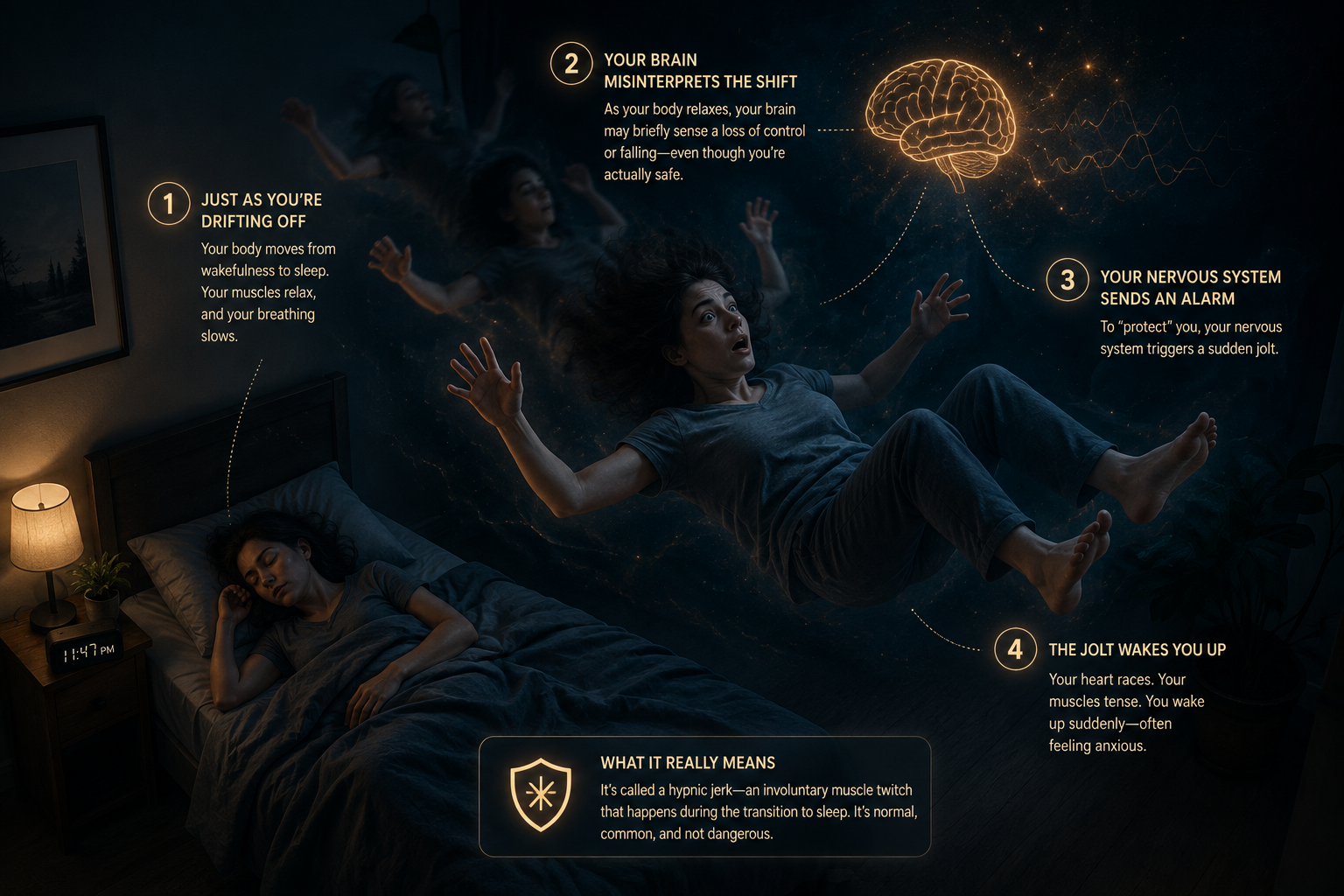
That feeling like falling when falling asleep is not your body failing.
It’s your nervous system reacting during the transition into sleep.
As you fall asleep, your body begins to power down:
- Your muscles relax
- Your breathing slows
- Your awareness fades
For most people, this happens smoothly.
But if your nervous system is slightly alert, that transition can feel unstable.
Your brain briefly “checks” what’s happening.
And that check can create a sudden sensation—like dropping, slipping, or falling.
This is often referred to as a hypnic jerk falling sensation.
Many people also call this a hypnic jerk or sleep start — a very common reflex that happens during the transition into sleep.
It’s a reflex.
Not a problem.
What It Feels Like
Even though everyone experiences it slightly differently, most people describe similar sensations:
- A sudden falling or dropping feeling in the body
- A quick jolt awake when falling asleep
- An adrenaline surge when falling asleep
- Your heart racing or pounding
- A brief moment of alertness or even panic when drifting off to sleep
The intensity can vary.
Sometimes it’s subtle.
Other times, it feels strong enough to fully wake you up.
But the key thing to understand is this:
These sensations are coming from your nervous system—not from danger.
Why It Happens Right As You Fall Asleep
The moment you fall asleep is a transition point.
And transitions are where your nervous system is most sensitive.
As your body lets go of control, your system briefly evaluates:
“Is it safe to fully relax?”
If your system is calm, it moves smoothly into sleep.
If it’s slightly activated, it may trigger a quick response.
That response can feel like:
- A drop
- A jolt
- A surge of energy
This is not your body malfunctioning.
It’s your body checking.
And then reacting.
Why It Keeps Happening
For many people, this doesn’t just happen once.
It repeats.
And that’s where it becomes frustrating.
This is because of a simple loop:
Awareness → monitoring → more activation
Here’s how it works:
- You feel the falling sensation
- You become more aware of your body
- You start watching for it to happen again
- Your nervous system becomes more alert
- The sensation becomes more likely
This doesn’t mean you’re doing anything wrong.
It means your system has learned a pattern.
And once a pattern is learned, your body repeats it automatically.
How This Connects to Sleep Anxiety
This experience is often part of a broader pattern known as sleep anxiety.
If you want to understand the full pattern behind these nighttime symptoms, read the complete guide on sleep anxiety help.
It can include:
- Falling sensations
- Adrenaline surges
- Jolting awake
- Racing heart at night
If this feels familiar, you can explore a deeper breakdown here:
You may also recognize patterns similar to an adrenaline rush when falling asleep or panic when falling asleep.
These are all different expressions of the same underlying process:
Many people experiencing this pattern also notice symptoms like body jolts, racing heartbeat, nighttime adrenaline surges, or panic when trying to sleep.
A nervous system that hasn’t fully settled at night.
A Deeper Layer: Nervous System Regulation
For some people, this isn’t just about sleep.
It connects to how the body regulates stress and energy more broadly.
When the system stays slightly activated, it can show up most clearly at night—when everything else becomes quiet.
This is why some people find benefit in approaches that focus on deeper regulation patterns, such as breathwork, EFT tapping, or body-based regulation approaches.
If you’re curious about that angle, you can explore this further here:
👉 EFT Tapping Reset for Stress & Anxiety
These approaches don’t force change—they help the body relearn safety.
This Is Not Dangerous — It’s a Pattern
This is the most important thing to understand.
The falling sensation when trying to sleep is not dangerous.
It’s a learned nervous system response.
For most people, this experience is benign and related to the normal transition into sleep.
Your body is reacting to a transition—not failing.
Even though it feels intense, it’s not harmful.
And because it’s a pattern, it can change.
A Gentle Next Step
If this is happening to you at night, you don’t need more information — you need something that helps your body settle in the moment.
I created a free 5-minute emergency sleep reset you can use when your body feels wired, panicky, or unable to shut off.
👉 Start the free reset here:
Free 5-Minute Emergency Sleep Reset
Frequently Asked Questions
This happens because your nervous system is reacting during the transition into sleep. As your body relaxes, your system may briefly activate, creating a falling or dropping sensation.
No. Even though it feels intense, it is not dangerous. It is a common nervous system response and does not indicate that something is wrong with your body.
Yes, in many cases this sensation is related to a hypnic jerk—a natural reflex that can occur as your body transitions into sleep.
The suddenness of the sensation can trigger a brief fear response. Your brain interprets the intensity as important, which can create a moment of panic.
Your nervous system activates briefly, which can increase your heart rate and create a sensation of alertness.
Yes. When your system is already slightly activated, these sensations can happen more frequently or feel more intense.
Yes. As your nervous system learns that it is safe to relax at night, these sensations often decrease and become much less noticeable.
Add your first comment to this post