
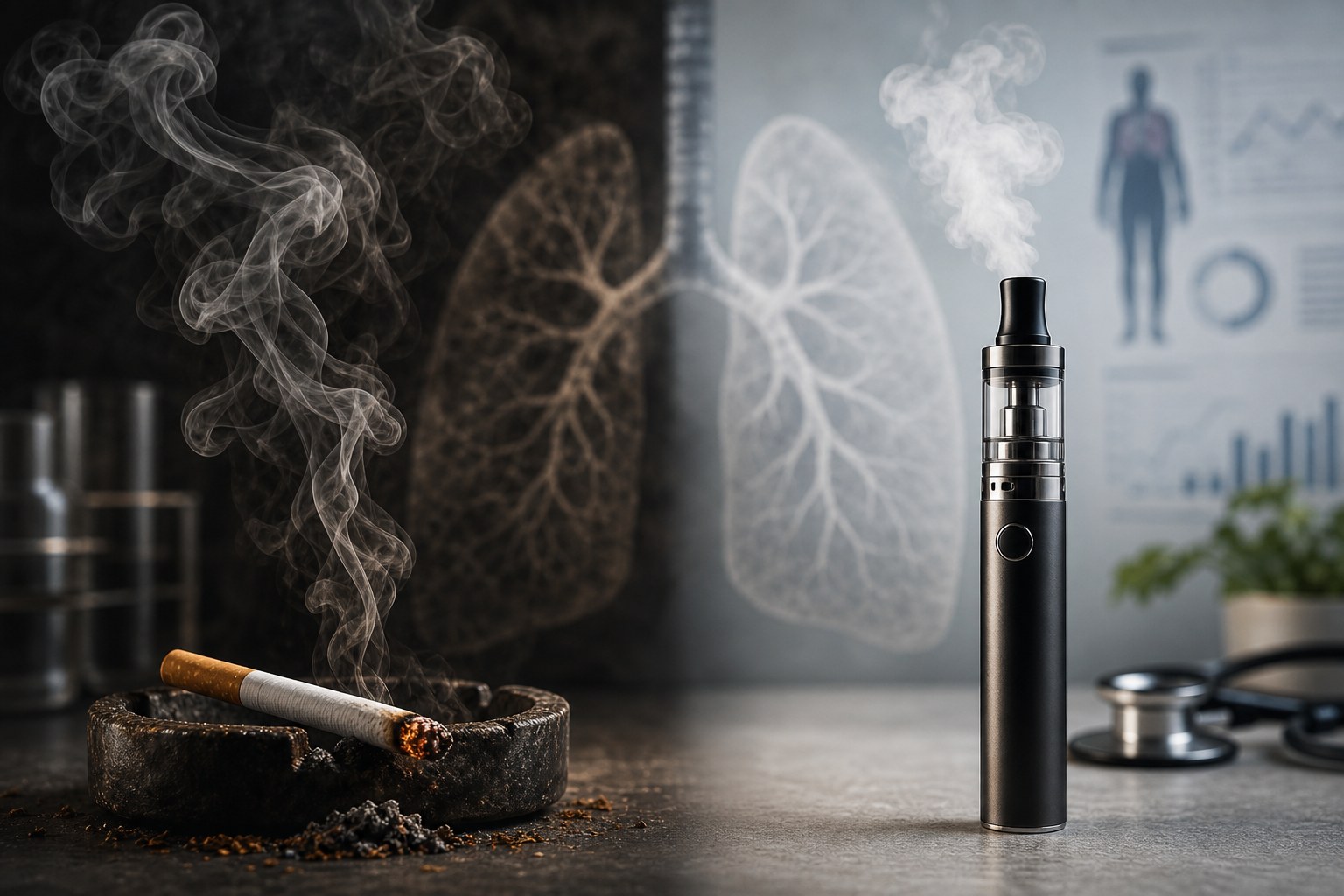
Many people ask the same question: is vaping or smoking worse? The honest answer is that both carry health risks, both can keep you dependent on nicotine, and neither should be treated as harmless.
Smoking exposes your body to thousands of chemicals from burned tobacco. Vaping may avoid combustion, but it still exposes your lungs and nervous system to nicotine, aerosol chemicals, flavoring agents, and habit-forming routines.
The real issue is not just which one is “worse.” The bigger question is: how do you break free from nicotine completely?
Looking for help quitting smoking or vaping? Start with our complete guide: Subconscious Quit Smoking Hub.
Table of Contents
- Vaping vs. Smoking: What This Article Really Answers
- Facts About Smoking
- Facts About Vaping
- Which Is Worse for Your Health — Vaping or Smoking?
- The Choice Is Yours: Vaping, Smoking, or Freedom?
- Why People Struggle to Quit Both Vaping and Smoking
- Conclusion: The Best Choice Is Freedom From Both
- Ready to Break Free From Nicotine?
- FAQs: Which is Worse Vaping or Smoking?
- Related Reading
Vaping vs. Smoking: What This Article Really Answers
This article compares vaping and smoking from a practical health perspective. Smoking is strongly linked to long-term disease because it involves burning tobacco and inhaling toxic smoke. Vaping may expose users to fewer combustion byproducts, but it is still not risk-free and can keep nicotine addiction alive.
So instead of asking which habit is “safe,” it is better to ask which path helps you move toward freedom, healing, and long-term health.
Facts About Smoking
- Smoking involves burning tobacco and inhaling smoke into the lungs.
- Cigarette smoke contains thousands of chemicals, including tar and carbon monoxide.
- Smoking is strongly linked to lung disease, heart disease, stroke, cancer, and reduced breathing capacity.
- Secondhand smoke can also affect people nearby.
- Smoking often becomes tied to stress relief, routines, identity, and emotional triggers.
For a deeper look at what smoking does over time, read: Smoking Consequences: Long-Term Effects.
Facts About Vaping
- Vaping uses an electronic device to heat liquid into an inhaled aerosol.
- Many vape products contain nicotine, which can be highly addictive.
- Vape aerosols may contain flavoring chemicals, ultrafine particles, metals, and other substances that can irritate the lungs.
- The long-term effects of vaping are still being studied.
- Vaping can become a replacement habit rather than true freedom from nicotine.
If you want a deeper breakdown of vaping risks, read: Top 10 Dire Harmful Effects of Vaping vs. Cigarettes.
Which Is Worse for Your Health — Vaping or Smoking?
Smoking is generally considered more harmful because it involves combustion. Burning tobacco creates tar, carbon monoxide, and many toxic chemicals that directly damage the lungs, heart, blood vessels, and other organs.
Vaping may reduce exposure to some smoke-related toxins, but that does not make it safe. Vape products can still contain nicotine and other substances that may affect the lungs, heart, brain, and nervous system.
The most important point is this: switching from cigarettes to vaping may reduce some risks, but staying dependent on nicotine keeps the addiction cycle alive.
If your real goal is to stop relying on nicotine, start here: Quitting Smoking: Where to Begin?.
The Choice Is Yours: Vaping, Smoking, or Freedom?
Many people compare vaping and smoking as if the goal is to pick the less harmful habit. But the strongest long-term choice is to move away from both.
Why Some People Choose Vaping
- It may expose users to fewer combustion chemicals than cigarettes.
- It may produce less odor than smoking.
- Some people use it as a transition away from cigarettes.
Why Vaping Can Still Be a Problem
- It can still contain nicotine.
- It can keep the hand-to-mouth habit alive.
- It can become a new dependency instead of true freedom.
- Its long-term health effects are still being studied.
Why Smoking Is So Harmful
- It exposes the body to toxic smoke and tar.
- It damages the lungs and cardiovascular system.
- It affects both smokers and people exposed to secondhand smoke.
- It often becomes deeply connected to stress, identity, and routine.
If you keep returning to nicotine even when you know the risks, the problem may be deeper than information. Learn how subconscious patterns affect quitting here: Why Willpower Fails—and What Actually Works to Quit Smoking.
Why People Struggle to Quit Both Vaping and Smoking
Most people do not keep smoking or vaping because they lack intelligence. They keep doing it because nicotine becomes connected to emotional relief, stress management, boredom, social habits, and identity.
That is why quitting can feel hard even when you understand the health risks. Your conscious mind wants freedom, but your subconscious mind may still associate nicotine with comfort, control, or relief.
This is where deeper subconscious work can help. Read more here: How Hypnosis Helps You Quit Smoking.
Conclusion: The Best Choice Is Freedom From Both
So, which is worse: vaping or smoking? Smoking is generally more damaging because of the toxic chemicals created by burning tobacco. But vaping is not harmless, especially when it keeps nicotine addiction active.
The healthiest long-term choice is not choosing between two nicotine habits. It is learning how to become free from both.
If you smoke, vape, or switch between the two, your next step is to address the deeper habit loop — the subconscious pattern that keeps nicotine feeling necessary.
Ready to Break Free From Nicotine?
Whether you currently smoke, vape, or use both, lasting freedom starts by changing the patterns that keep nicotine in your life.
Explore the free quit smoking hypnosis program and begin building a healthier smoke-free future today.
FAQs: Which is Worse Vaping or Smoking?
In 2023, the health implications of vaping versus smoking continue to be a significant topic of discussion. Emerging research provides new insights into how vaping and smoking differently impact our health, with each carrying its own set of risks. So, which is worse vaping or smoking? Only time will tell.
The equivalence of vape puffs to a traditional cigarette varies, depending on factors like the vape’s nicotine content and the user’s inhalation style. This comparison is complex and cannot be generalized accurately.
Vaping’s impact on lung health has been a subject of extensive study. While perceived as a safer alternative to smoking, vaping still poses risks to lung health, including potential exposure to harmful substances.
Quitting vaping can lead to improvements in lung health. The extent of healing depends on various factors, including the duration and intensity of vaping habits and individual health conditions.
Not inhaling vape can reduce exposure to certain harmful substances. However, it is important to note that even without inhalation, there are still potential risks associated with the chemicals in vape products.
The term “healthiest” can be misleading when discussing vapes. No vape product is considered completely safe, as all contain chemicals and substances that may pose health risks.
Some vapes are marketed as smoking cessation tools. However, the safety of these products can vary. It’s crucial to consult healthcare professionals for advice on safe and effective smoking cessation methods.
Vaping can have detrimental effects on dental health. Nicotine in vape products can contribute to gum disease, tooth decay, and other oral health issues.
Related Reading
Top 10 Dire Harmful Effects of Vaping vs. Cigarettes
Smoking Consequences: Long-Term Effects
Add your first comment to this post