QUIT SMOKING RESOURCE CENTER
Quit Smoking Naturally with Hypnosis: The Complete Guide to Becoming a Non-Smoker
If you’ve tried patches, nicotine gum, vaping, medications, or sheer willpower and still find yourself reaching for cigarettes, there may be more happening than nicotine alone.
Smoking becomes connected to routines, emotional triggers, stress relief, identity, and subconscious patterns that can keep pulling you back—even when you genuinely want to quit.
Understand what keeps the habit alive. Change the pattern. Become a non-smoker from the inside out.

You want to quit.
You may have wanted to quit for months—or even years. You know what smoking is costing you. You’re tired of the smell, the expense, the cravings, and the feeling that cigarettes have more control over your life than they should.
And yet somehow… you keep reaching for another one.
Maybe you’ve tried patches.
Nicotine gum.
Vaping.
Medication.
Cold turkey.
Pure willpower.
Maybe you’ve even quit successfully for days, weeks, or months—only to find yourself smoking again.
Sometimes that leaves you wondering:
“Why do I still want a cigarette when I genuinely want to quit?”
“Why does the craving feel so automatic?”
“Why can’t I just decide I’m done and be done?”
If you’re trying to quit smoking naturally, one of the most important things to understand is this:
Smoking is more than a nicotine habit.
Over time, cigarettes can become connected to stress, emotions, routines, social situations, breaks, rewards, and even your sense of identity.
Your subconscious begins learning associations:
Stress → cigarette.
Coffee → cigarette.
Driving → cigarette.
After dinner → cigarette.
Feeling overwhelmed → cigarette.
Eventually, reaching for a cigarette can happen before you’ve consciously decided to smoke.
That’s one reason willpower alone can feel like such a battle. You’re consciously saying “I want to quit” while learned patterns are still automatically saying “this is what we do.”
The goal isn’t simply to spend the rest of your life resisting cigarettes.
The deeper goal is to change the patterns that keep creating the desire for them.
This guide will help you understand why smoking can become so deeply conditioned, why cravings and relapse happen, how hypnosis can help address subconscious associations, and how you can begin moving toward life as a non-smoker.
You’ll understand why smoking becomes so deeply conditioned, what keeps cravings and relapse alive, and how you can begin changing the patterns behind the habit.
- Why quitting smoking can feel so difficult
- Why willpower alone often fails
- How triggers and subconscious associations create cravings
- How smoker identity can keep the habit alive
- How hypnosis can help you become a non-smoker
- Why Quitting Smoking Feels So Difficult
- Why Willpower Alone Usually Fails
- The Smoking Trigger Loop
- Understanding Smoker Identity
- How Hypnosis Helps You Quit Smoking
- Explore the Quit Smoking Resource Library
- The Benefits of Becoming a Non-Smoker
- Healing After Quitting Smoking
- Start Your Smoke-Free Journey
- Frequently Asked Questions
- Take the First Step Toward Freedom
Why Quitting Smoking Feels So Difficult
Most people think smoking is only a nicotine problem.
But long-term smoking becomes connected to daily routines, emotional coping, stress relief, and personal identity.
You may automatically crave a cigarette when you are:
- Drinking coffee
- Driving
- Feeling stressed
- Taking a work break
- Socializing
- Feeling anxious
Over time, your subconscious mind links cigarettes with comfort, control, familiarity, and relief.
This is why quitting can feel like losing a part of yourself instead of simply stopping a habit.
Why Willpower Alone Usually Fails
Willpower operates at the conscious level.
Smoking habits operate mostly at the subconscious level.
That creates an inner conflict. One part of you wants to quit. Another part still believes smoking helps you feel calm, focused, safe, or in control.
The cycle often looks like this:
1. Get motivated to quit
↓
2. Stop for a while
↓
3. Stress or a familiar trigger appears
↓
4. The craving returns
↓
5. Smoke again — and feel defeated
Real freedom happens when the subconscious pattern changes—not when you spend your life fighting it.
The Smoking Trigger Loop
Most cravings are not random.
They are triggered responses created through repetition.
Common smoking triggers include stress, coffee, alcohol, driving, anxiety, boredom, work breaks, and social pressure.
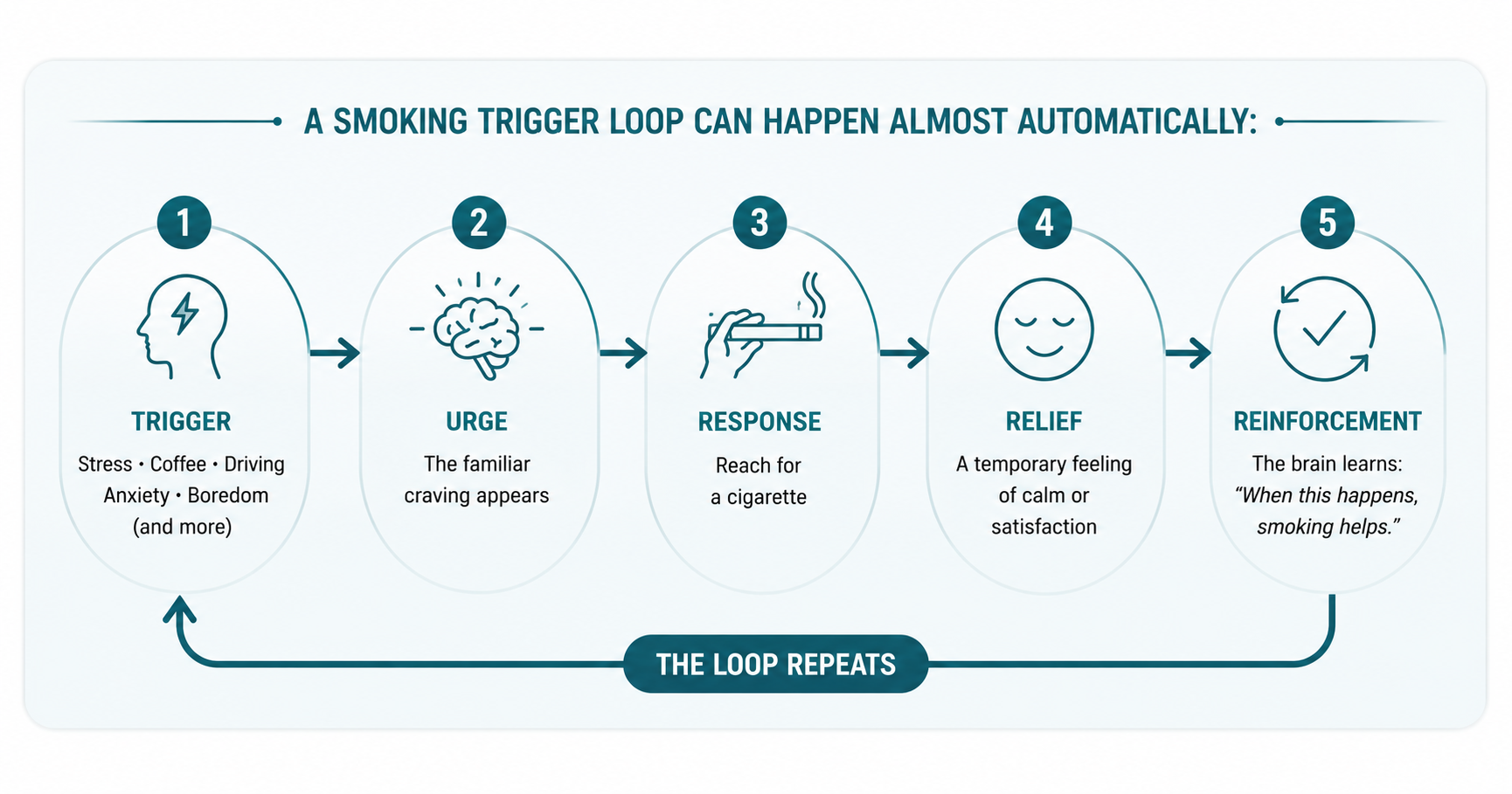
Every time the pattern repeats, the association can become stronger. Eventually, the trigger itself may be enough to activate the urge before you’ve consciously decided to smoke.
The goal isn’t to spend your life resisting the craving. It’s to interrupt the pattern that keeps creating it.
Understanding your smoking triggers is one of the fastest ways to identify the subconscious patterns that keep cravings alive.
Understanding Smoker Identity
One of the most overlooked parts of quitting is identity.
Many people keep seeing themselves as “a smoker trying to quit.”
THE IDENTITY SHIFT
OLD IDENTITY
“I’m a smoker trying to quit.”
↓
TRANSITION
“I’m changing the patterns that kept me smoking.”
↓
NEW IDENTITY
“I’m a non-smoker. Cigarettes are no longer part of who I am.”
The goal isn’t to spend your life identifying as someone who is resisting cigarettes.
The deeper shift happens when smoking stops feeling like something you are constantly giving up—and begins feeling like something that simply no longer belongs in your life.
When identity changes, maintaining the new behavior can become much easier.
How Hypnosis Helps You Quit Smoking
Hypnosis works differently than willpower.
Instead of forcing yourself to resist cravings, hypnosis helps retrain the subconscious patterns that created the cravings in the first place.
In a relaxed, focused state, your subconscious becomes more receptive to new instructions, healthier associations, and a new identity.
Quit smoking hypnosis can help you:
Instead of constantly fighting the urge, the urge itself can begin to fade.
Explore the Quit Smoking Resource Library
Quitting smoking is not one problem. It is a system of triggers, identity patterns, stress loops, cravings, fear, and habit conditioning. Use the guides below to understand the specific piece that has kept you stuck.
The Benefits of Becoming a Non-Smoker
Becoming smoke-free changes more than your lungs.
Many people experience:
The biggest win isn’t simply that you stop smoking. It’s that cigarettes stop having control over your choices, your routines, and your life.
Healing After Quitting Smoking
Your body begins healing soon after you stop smoking.
But healing is not only physical. There is also a mental and emotional reset that happens as your subconscious learns a new way to handle stress, routine, and identity.
This is why support matters.
When you address both the body and the subconscious mind, quitting becomes less about punishment and more about returning to freedom.
Many smokers delay quitting because they fear gaining weight. Learn the truth about weight gain after quitting smoking and how to manage it successfully.
Start Your Smoke-Free Journey
You don’t have to figure out your next step alone. Start with the free experience, and if you’re ready to go further, continue into the complete program.
FREE: Breathe Free — The Smoking Release Activation
The best first step is the free Breathe Free: The Smoking Release Activation.
This 6-part audio experience is designed to help you begin rewiring the subconscious patterns that keep smoking in place.
Inside the free program, you’ll experience:
You do not have to force yourself to quit before you begin. You just have to press play and let the process start working at the level where the habit actually lives.
GO DEEPER: Breathe Free — The 10-Step Freedom Plan
When you’re ready to go beyond the first shift, Breathe Free: The 10-Step Freedom Plan takes you deeper into the subconscious patterns, emotional triggers, and identity connections that keep smoking in place.
This complete quit-smoking hypnosis program is designed to help you strengthen your non-smoker identity and create lasting change at the level where the habit actually lives.
Inside the complete program, you’ll work through:
This is where quitting becomes more than stopping a behavior. You begin changing the patterns, emotional connections, and identity that allowed smoking to remain part of your life.
Frequently Asked Questions
Hypnosis can help many people quit because it works with the subconscious patterns, triggers, and identity loops that keep the smoking habit active.
No. The free program is designed to help you begin changing the subconscious desire to smoke. You do not have to force yourself to quit before starting.
No. Nicotine plays a role, but many people continue craving cigarettes because of emotional triggers, routines, stress patterns, and identity associations.
That is exactly why this approach focuses on the subconscious mind. Instead of only treating the surface habit, it helps address the deeper pattern behind the behavior.
The free program includes 6 short audio sessions designed to be completed within 4 days.
Take the First Step Toward Freedom
You do not need to spend the rest of your life fighting cravings.
The goal is not to become someone who constantly resists smoking.
The goal is to become someone who simply no longer needs it.
Start with the free Breathe Free: The Smoking Release Activation and begin changing the patterns that keep smoking in place.