
SUBCONSCIOUS WEIGHT LOSS RESOURCE CENTER
Subconscious Weight Loss: The Complete Guide to Releasing Weight from the Inside Out
Most weight loss advice focuses on food, exercise, and willpower—but lasting change often depends on what’s happening beneath the surface.
Your subconscious mind influences cravings, emotional eating, motivation, self-image, habits, and even how safe your body feels releasing weight.
Understand what keeps the struggle alive. Change the pattern. Create lasting change from the inside out.

You want to lose weight.
Maybe you’ve wanted to for months—or even years. You know what you should be doing. You understand nutrition. You’ve probably tried more than one approach.
And yet somehow… you keep finding yourself back in the same patterns.
Maybe you’ve tried dieting.
Counting calories.
Cutting carbohydrates.
Intermittent fasting.
Exercise programs.
Pure willpower.
Maybe you’ve even lost weight successfully—only to watch it slowly return.
Sometimes that leaves you wondering:
“Why do I keep craving foods I genuinely want to stop eating?”
“Why do I eat when I’m stressed, tired, bored, or overwhelmed?”
“Why can’t I just decide to change and make it stick?”
If you’re trying to create lasting weight loss, one of the most important things to understand is this:
Weight loss is about more than knowing what to eat.
Over time, food and eating can become connected to stress, emotions, comfort, reward, routines, self-image, and even your sense of safety.
Your subconscious begins learning associations:
Stress → food.
Exhaustion → food.
Boredom → food.
Reward → food.
Feeling overwhelmed → food.
Eventually, reaching for food can happen before you’ve consciously decided what you actually want.
That’s one reason willpower alone can feel like such a battle. You’re consciously saying “I want to lose weight” while learned patterns may still be automatically saying “this is what we do.”
The goal isn’t simply to spend the rest of your life fighting cravings, restricting yourself, or forcing yourself to make the “right” choice.
The deeper goal is to change the patterns that keep creating the struggle.
This guide will help you understand how subconscious patterns can influence eating, cravings, motivation, self-image, and weight—and how approaches such as hypnosis and subconscious reprogramming can help support lasting change from the inside out.
You’ll understand why lasting weight loss can feel so difficult, what keeps cravings and old eating patterns alive, and how you can begin changing the subconscious patterns behind the struggle.
- What Is Subconscious Weight Loss?
- Why Traditional Weight Loss Methods Often Fail
- How the Subconscious Mind Influences Weight Loss
- The Mind-Body Weight Loss Connection
- Why Weight Loss Feels Different for Different People
- Why Willpower Alone Is Not Enough
- Why Most Weight Loss Advice Addresses Symptoms Instead of Causes
- The Hidden Role of Habits in Weight Loss
- Emotional Eating and Hidden Weight Patterns
- Why Motivation Comes and Goes
- Why Self-Sabotage Is Not What You Think
- Why Identity Matters More Than Willpower
- Why Your Body May Not Feel Safe Losing Weight
- Can Hypnosis Help With Weight Loss?
- The Quantum Reset Method
- Start With the Free Weight Code Reset Activation
- Ready for Deeper Transformation?
- Explore the Weight Loss Resource Library
- Frequently Asked Questions
- Final Thoughts
- About Dr. Gary Danko
What Is Subconscious Weight Loss?
Subconscious weight loss is an approach that focuses on the hidden emotional, mental, behavioral, and identity-based patterns that influence your relationship with food and weight.
Most weight loss programs focus almost exclusively on behavior:
- What should you eat?
- What should you avoid?
- How much should you exercise?
- How can you stay motivated?
But subconscious weight loss asks a different set of questions:
- Why do I keep losing motivation?
- Why do I sabotage myself after making progress?
- Why does food feel comforting when I am stressed?
- Why do old habits keep returning?
- Why does my body seem to resist change?
Your subconscious mind stores habits, emotional associations, beliefs, memories, identity patterns, and protective responses.
Many of these patterns operate automatically.
You do not consciously choose them.
They simply run in the background.
If your subconscious mind associates food with comfort, safety, relief, reward, connection, or protection, changing eating habits can feel far more difficult than simply following a meal plan.
Subconscious beliefs can sound like:
Those beliefs can quietly influence behavior even when you consciously want something different.
Subconscious weight loss works by changing the programming beneath behavior rather than trying to force new behaviors on top of old patterns.
For a deeper explanation, read Subconscious Weight Loss: Why It Works When Diets Fail.
Why Traditional Weight Loss Methods Often Fail
Most diets focus on controlling behavior.
The traditional weight-loss message is usually simple:
- Eat less.
- Move more.
- Track everything.
- Stay disciplined.
- Use more willpower.
Those strategies can absolutely produce short-term results.
The problem is that they often fail to address the deeper emotional and subconscious patterns driving behavior.
This is why so many people experience the same frustrating cycle.
The Weight-Loss Rebound Cycle
- They start motivated.
- They follow the plan.
- They lose weight.
- Stress increases.
- Old habits return.
- The weight comes back.
- They blame themselves.
Many people assume this means they lack discipline.
In reality, the issue is often subconscious resistance.
If food has become emotional comfort, dieting can feel threatening.
If your identity still says, “I am someone who struggles with weight,” success may feel temporary.
If your body associates weight with safety, part of you may resist releasing it.
This creates internal conflict.
One part of you wants change.
Another part wants familiarity.
And familiarity often wins.
To understand this cycle more deeply, read Why Your Efforts Don’t Stick: The Subconscious Weight-Loss Rebound Loop.
How the Subconscious Mind Influences Weight Loss
The subconscious mind stores learned experiences and turns them into automatic patterns.
Those patterns influence behavior long before conscious willpower gets involved.
Your subconscious may have learned messages like these:
- Food helps me relax.
- Eating helps me feel better.
- Sweets reduce stress.
- I deserve a reward after a hard day.
- Weight loss is difficult.
- People like me always struggle with weight.
These beliefs may not be consciously obvious.
You may not even agree with them.
But if they exist below awareness, they can still shape cravings, choices, emotions, and habits.
This is why many people feel like they are fighting themselves.
One part wants to change.
Another part keeps repeating the old pattern.
The result often feels like self-sabotage.
Subconscious weight loss helps reduce that internal conflict by changing the deeper beliefs, associations, and habits that influence behavior.
Learn more in Reprogram Your Subconscious Mind for Weight Loss and How to Retrain Your Brain to Lose Weight.
The Mind-Body Weight Loss Connection
Weight loss is not only physical.
Your mind, emotions, nervous system, hormones, habits, and identity all influence how your body responds.
STRESS
Can increase cravings.
SHAME
Can trigger emotional eating.
ANXIETY
Can make comfort food more appealing.
SELF-IMAGE
Can undermine consistency.
When the mind and body are working against each other, healthy habits often feel exhausting.
When the mind and body begin working together, healthy choices can feel more natural.
This is one reason long-term weight loss often requires emotional and subconscious change in addition to behavioral change.
For more on this topic, read The Mind-Body Weight Loss Connection: Why Your Mindset Matters.
Why Weight Loss Feels Different for Different People
Have you ever noticed that one person can follow a plan and succeed while another struggles despite doing everything right?
The reason is that weight loss is not only about the plan.
It is also about the subconscious meaning attached to the plan.
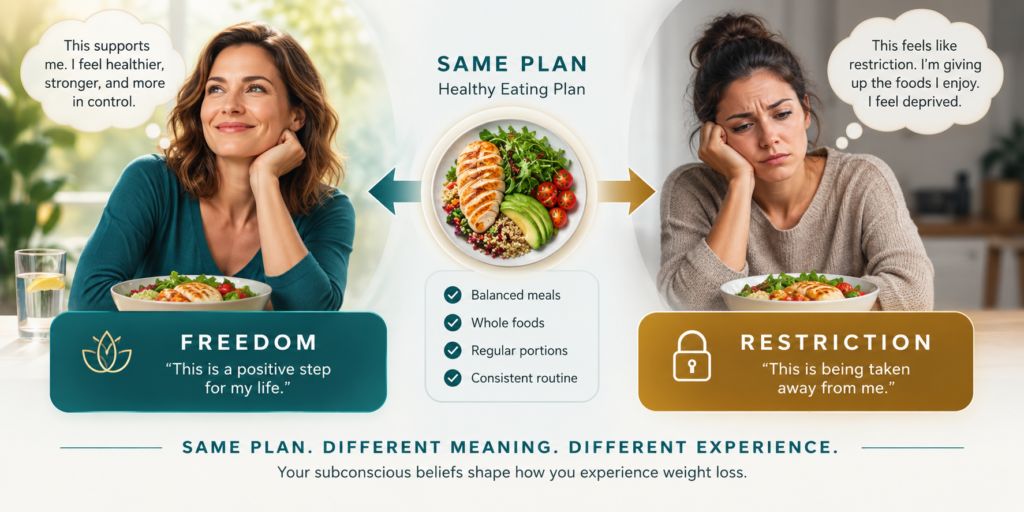
One person may feel excited about losing weight.
Another may unconsciously fear the attention, visibility, vulnerability, or pressure that comes with change.
No two people have the same emotional history.
No two people carry the same subconscious beliefs.
No two people have the same relationship with food, comfort, identity, and safety.
This is why generic weight loss advice often falls short.
The subconscious patterns behind behavior matter just as much as the behavior itself.
Why Willpower Alone Is Not Enough
Willpower can help you start.
It rarely creates lasting transformation by itself.
Willpower is a limited resource.
When weight loss depends entirely on force and self-control, progress often becomes fragile.
This is why many people can stay disciplined for days, weeks, or even months and still eventually return to old habits.
THE SHIFT
The goal is not to eliminate discipline. It is to reduce the amount of force required.
As subconscious beliefs, habits, identity patterns, and emotional associations begin changing, healthy choices often become easier and more natural.
Instead of constantly fighting yourself, you begin aligning with the person you are becoming.
Why Most Weight Loss Advice Addresses Symptoms Instead of Causes
Many weight loss programs focus on symptoms.
They focus on overeating, cravings, emotional eating, weight gain, lack of exercise, and poor consistency.
But those symptoms often have deeper causes.
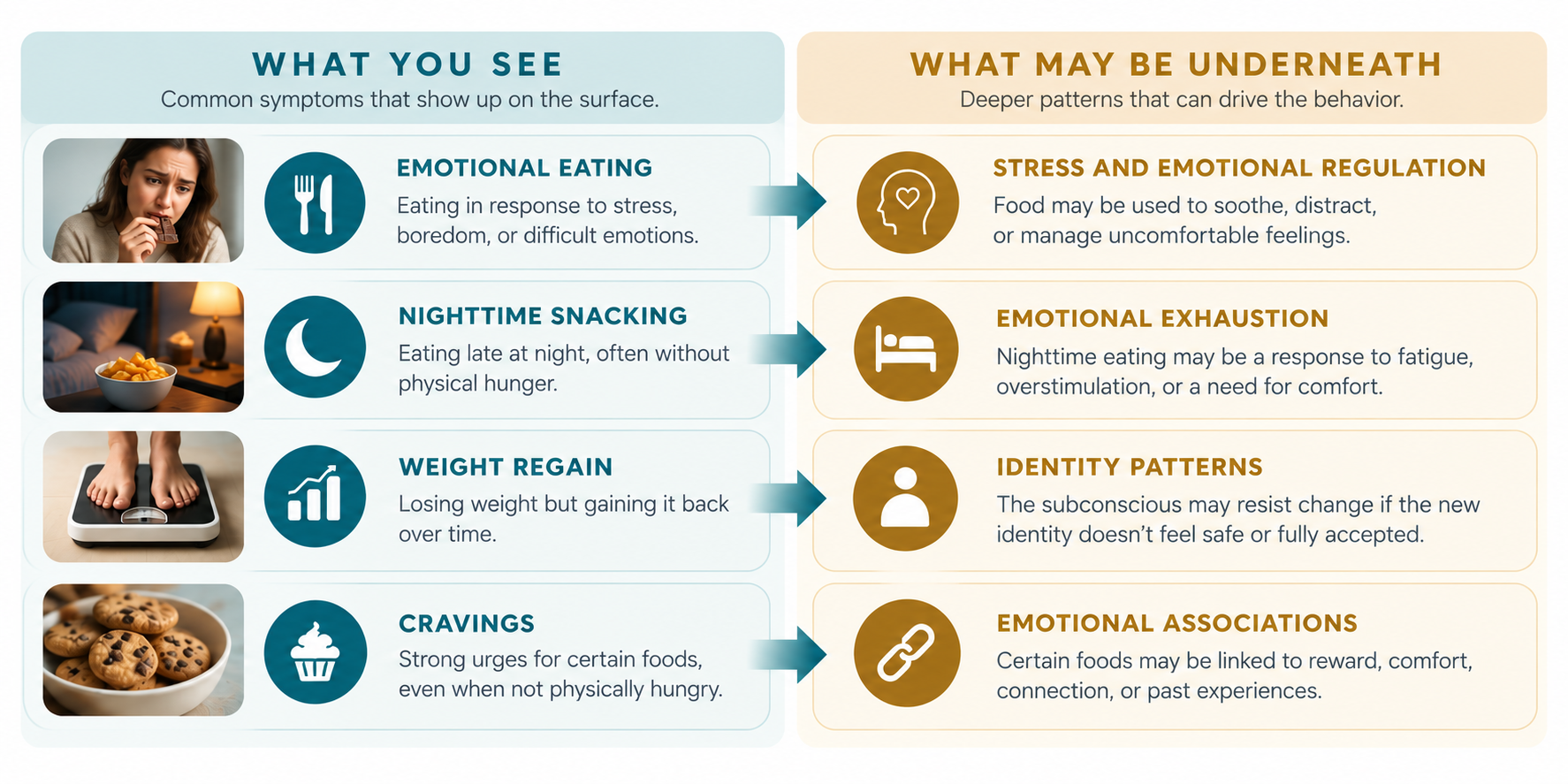
If the deeper cause remains unchanged, the symptom often returns.
This is why so many people feel like they are solving the same problem over and over again.
Subconscious weight loss seeks to address the root pattern rather than only the surface behavior.
The Hidden Role of Habits in Weight Loss
Habits are powerful because they operate automatically.
You do not consciously decide every behavior.
Many habits run on autopilot.
HOW THE HABIT LOOP WORKS
This is why eating patterns often feel automatic.
You may not consciously decide to snack.
You simply find yourself doing it.
Changing habits requires more than awareness.
THE DEEPER SHIFT
Changing a habit means changing the emotional and subconscious patterns that keep the habit alive.
Continue below to explore emotional eating, motivation, identity, body safety, self-sabotage, and how hypnosis can help create lasting change.
For more, read Subconscious Habits for Weight Loss.
Emotional Eating and Hidden Weight Patterns
Many people do not struggle with weight because they lack nutritional knowledge.
They struggle because food has become connected to emotions.
HOW EMOTIONAL EATING BECOMES A PATTERN
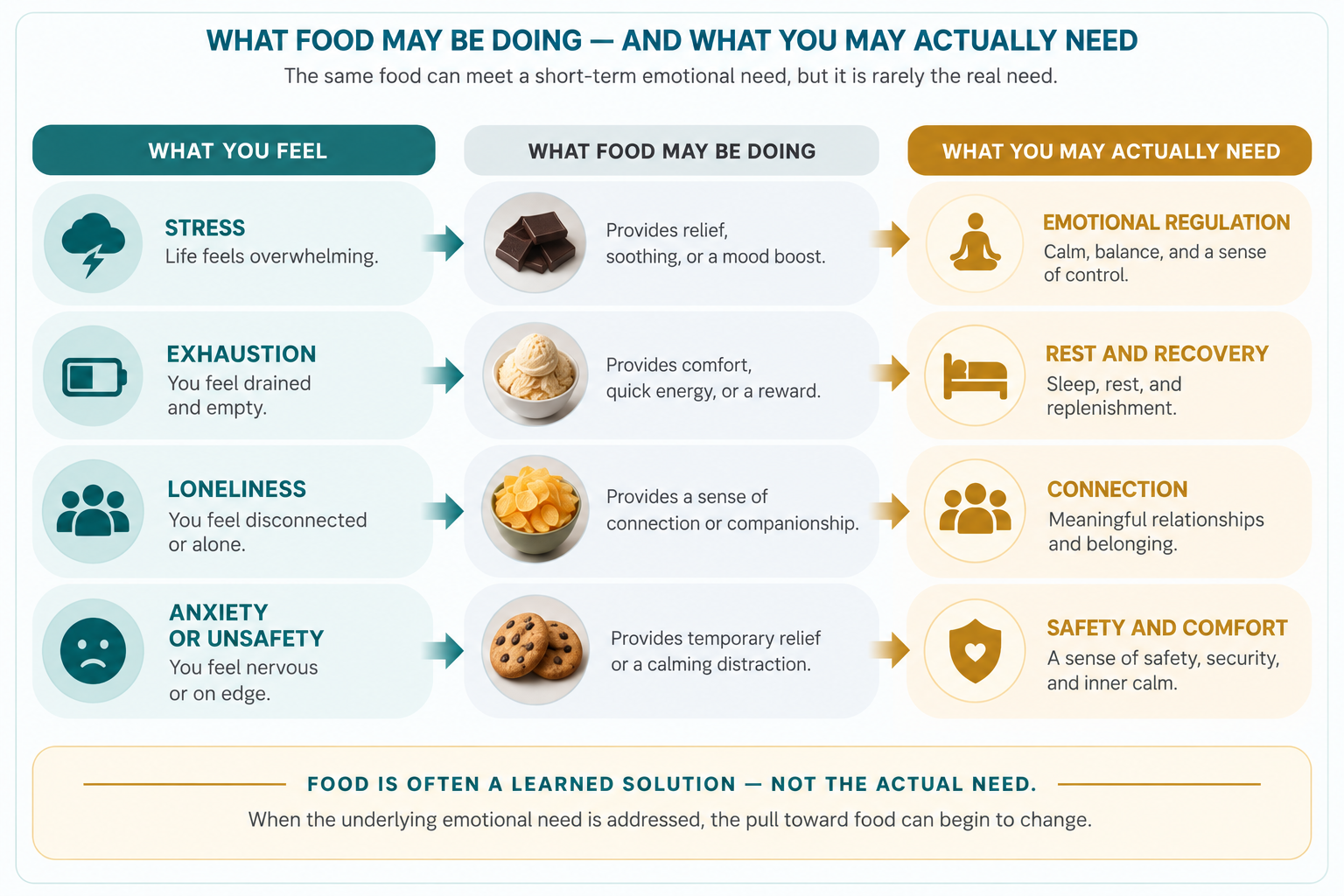
When this happens, eating becomes more than physical nourishment.
It becomes emotional regulation.
The challenge is that emotional eating provides temporary relief while often creating long-term frustration.
You may promise yourself that tomorrow will be different, only to find yourself repeating the same patterns again and again.
THE DEEPER PATTERN
This cycle is rarely about weakness.
More often, it reflects subconscious emotional programming that has never been addressed at the root.
If emotional eating has become part of your life, start with How to Stop Emotional Eating Subconsciously and Why Your Emotions Turn Into Weight.
You may also benefit from understanding why stress often creates physical resistance to weight loss through Why Your Body Holds Onto Weight During Stress and Why Stress Makes Your Body Create Emergency Weight.
Why Motivation Comes and Goes
One of the most frustrating parts of weight loss is motivation.
You may feel completely committed one week and completely disconnected the next.
Many people assume this means they lack discipline.
In reality, motivation problems are often symptoms of deeper subconscious conflicts.
WHY MOTIVATION FEELS UNRELIABLE
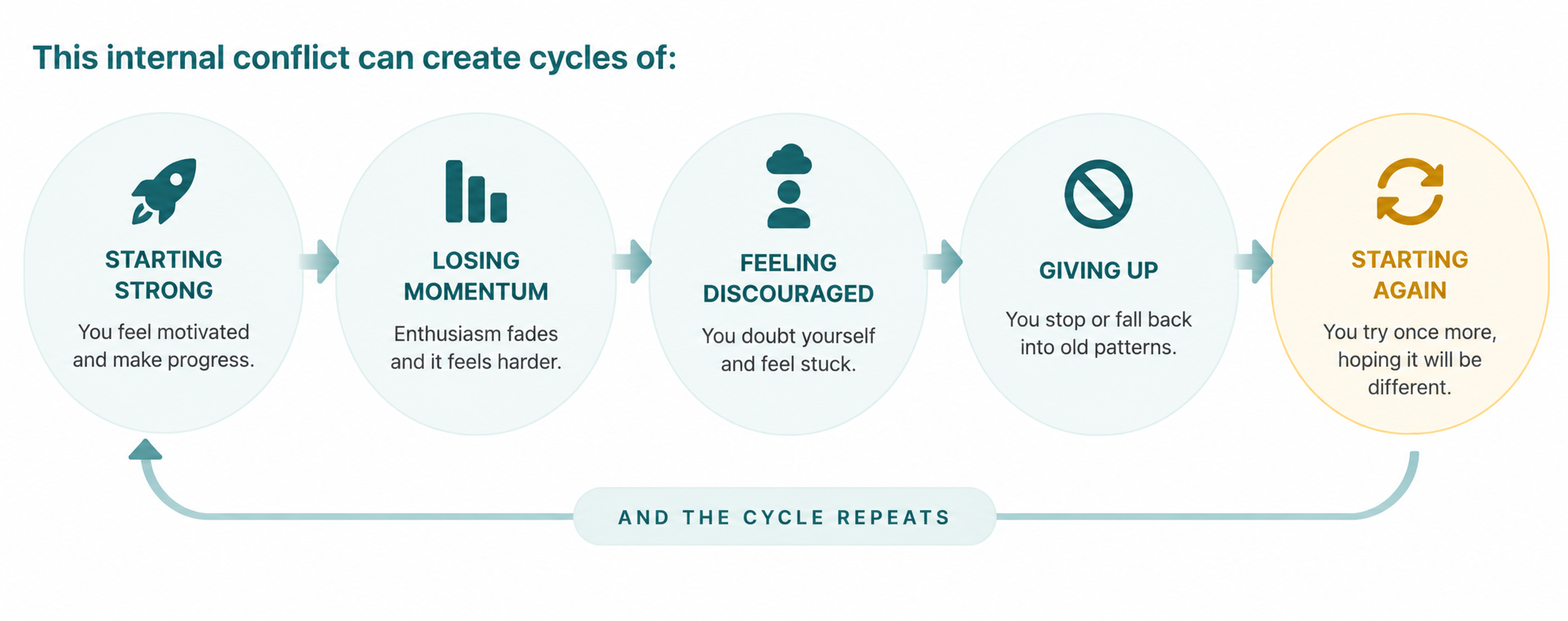
When subconscious resistance exists, motivation becomes unreliable because your mind is receiving mixed signals.
THE REAL GOAL
Lasting change is not about forcing yourself to stay motivated.
It is about reducing the conflict between the part of you pushing toward change and the part pulling toward familiarity.
As that conflict decreases, healthy actions can begin to feel more natural and sustainable.
To learn more, read How to Stay Motivated to Lose Weight Subconsciously, The Real Reason You Lose Motivation to Lose Weight, and Subconscious Weight Loss Motivation.
Why Self-Sabotage Is Not What You Think
Most people assume self-sabotage means they are lazy, weak, or somehow do not want success.
That interpretation is usually wrong.
Self-sabotage is often a form of subconscious protection.
Your subconscious mind is designed to keep you safe.
If it believes change creates risk, it may unconsciously pull you back toward familiar patterns.
The risk may not be logical. It may be emotional — based on what change has come to mean to you beneath conscious awareness.
For example, part of you may associate weight loss with:
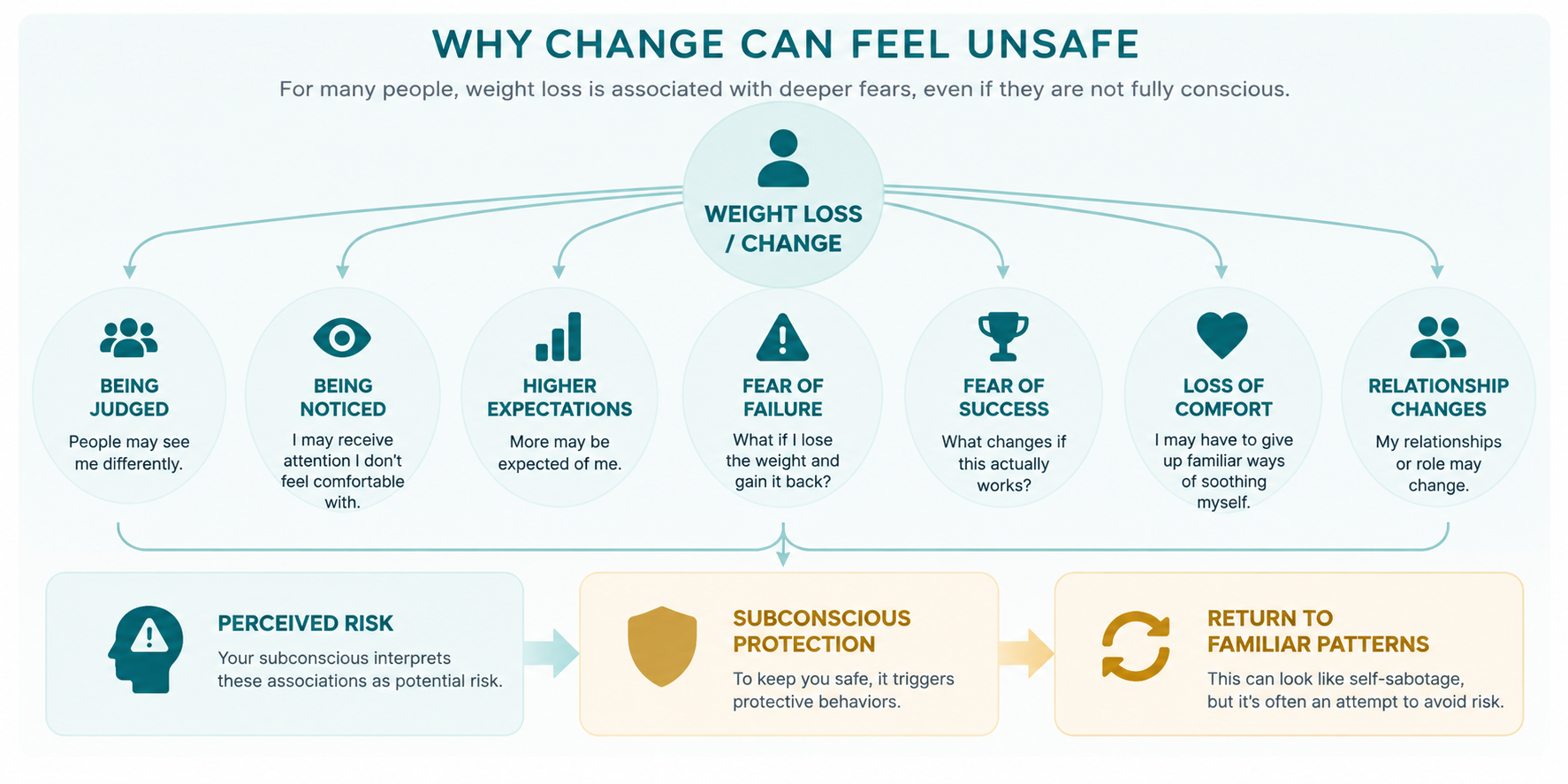
When those fears exist beneath awareness, the subconscious mind may create behaviors that seem irrational.
You may lose motivation, overeat after making progress, or find yourself returning to old habits—not because you consciously want to undo your progress, but because familiar patterns can feel safer to the subconscious mind.
What looks like self-sabotage from the outside may actually be subconscious protection.
To explore this further, read Why Your Identity Keeps Sabotaging Weight Loss and Why You Sabotage Weight Loss at Night.
Why Identity Matters More Than Willpower
Most people focus on changing behaviors.
Few people focus on changing identity.
Yet identity is often what determines whether weight loss lasts.
Your behavior will often align with those expectations.
This is why lasting transformation usually requires more than changing what you do.
It requires changing how you see yourself.
As your identity changes, new habits begin to feel more natural because they align with who you believe you are becoming.
This is one of the most overlooked aspects of successful weight loss.
Explore this further in Why Your Identity Keeps Sabotaging Weight Loss and Subconscious Habits for Weight Loss.
Why Your Body May Not Feel Safe Losing Weight
One of the most powerful discoveries in subconscious weight loss is that resistance is not always about food.
Sometimes, the deeper issue is safety.
Your subconscious mind is designed to protect you.
If it believes weight provides protection, comfort, invisibility, emotional security, or familiarity, it may unconsciously resist weight loss efforts.
This does not mean you consciously want to stay stuck. It means part of your system may still associate weight with survival.
This concept helps explain why some people can follow the right plan and still struggle to create lasting results.
Until the subconscious mind feels safe changing, progress can feel like pushing against an invisible wall.
This is one of the core principles behind the Quantum Reset Method.
To learn more, read Why Your Body Doesn’t Feel Safe Losing Weight.
Can Hypnosis Help With Weight Loss?
Hypnosis works differently than traditional weight loss strategies.
Rather than focusing only on conscious behavior, hypnosis works with the subconscious mind where habits, emotional associations, beliefs, and identity patterns are stored.

Instead of constantly fighting yourself, hypnosis aims to create alignment between your conscious goals and subconscious programming.
As subconscious beliefs begin to change, behaviors often become easier to sustain because they no longer feel like a constant battle.
For a deeper understanding, read Weight Loss Hypnosis: How to Lose Weight Without Dieting and Unlock Your Weight Loss Potential with Hypnosis.
Now that you understand the subconscious patterns behind weight loss, let’s explore the Quantum Reset Method and how to begin transforming those patterns from the inside out.
The Quantum Reset Method
Most weight loss programs focus almost exclusively on food and exercise.
The Quantum Reset Method is a subconscious weight loss approach designed to help people address the deeper emotional, mental, and behavioral patterns that often keep them stuck.
The Quantum Reset Method recognizes that habits are often symptoms of deeper subconscious programming.
Rather than simply trying to control behavior, the goal is to identify and transform the underlying patterns that drive cravings, emotional eating, self-sabotage, low motivation, and weight-loss resistance.
THE QUANTUM RESET METHOD FOCUSES ON
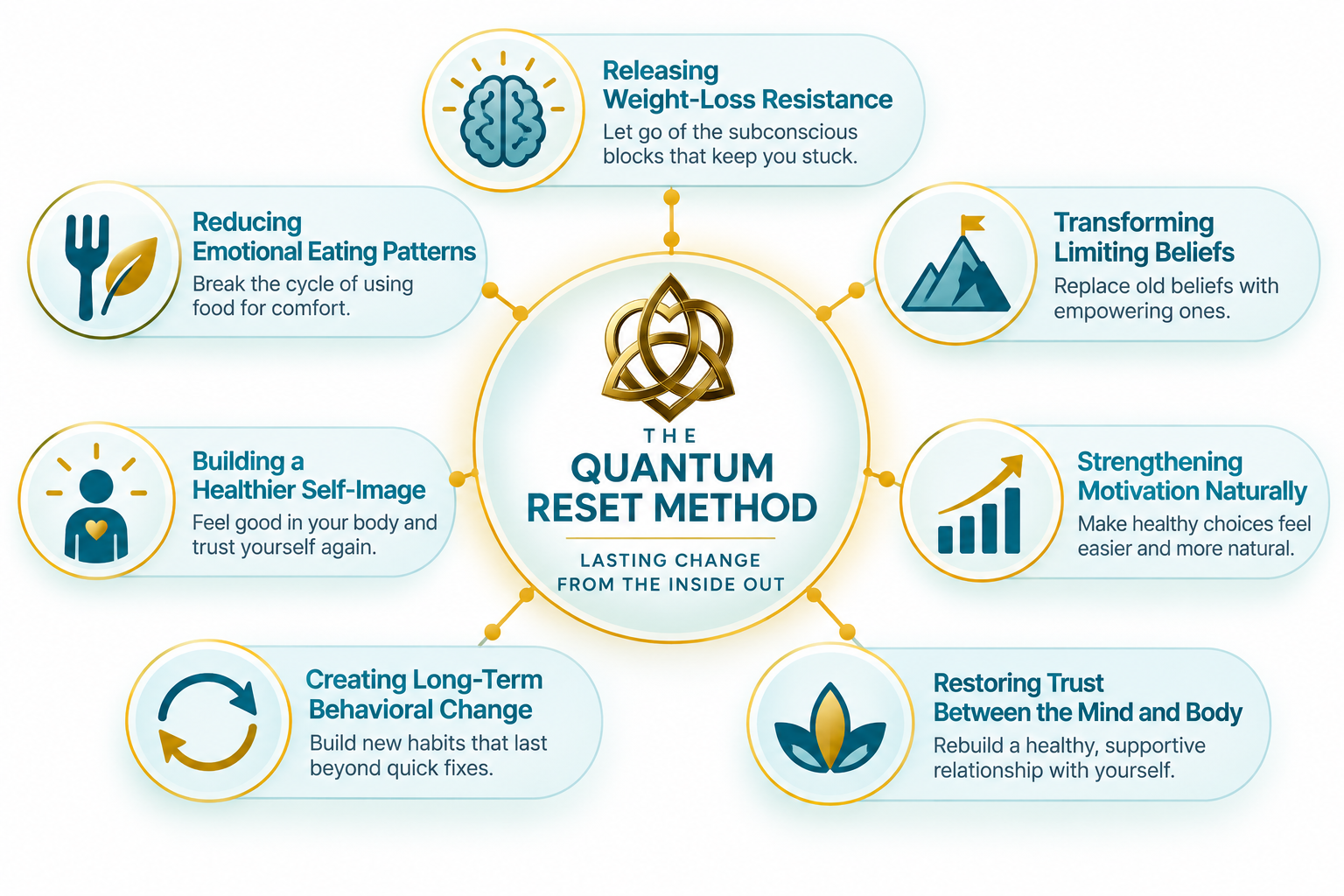
Unlike traditional dieting approaches, the Quantum Reset Method works from the inside out.
As subconscious beliefs begin to change, behaviors often become easier to sustain because they no longer require constant force and self-control.
To learn more about this approach, read Discover the Quantum Reset Method: A Powerful New and Innovative Method for Weight Management.
Start With the Free Weight Code Reset Activation
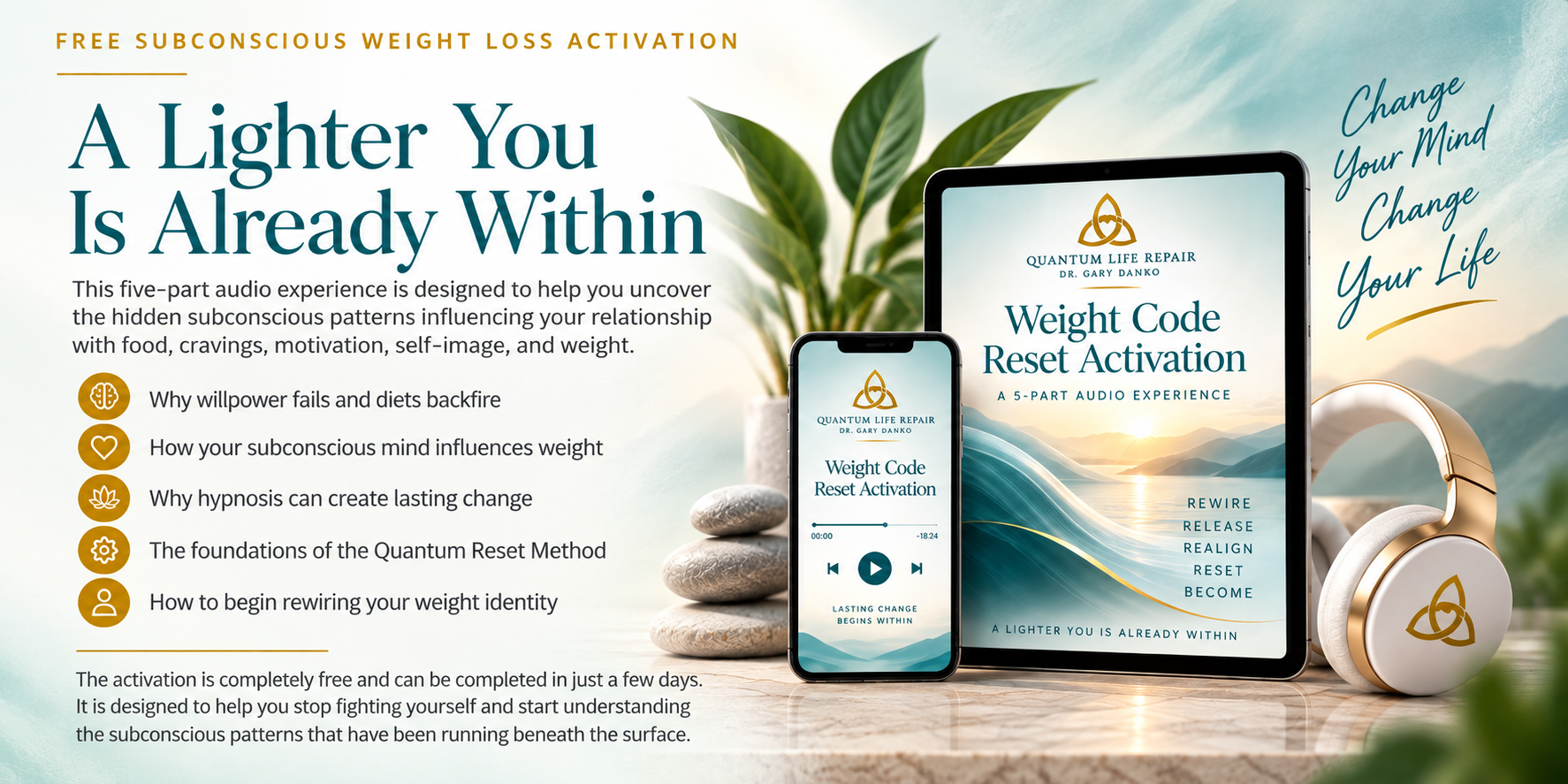
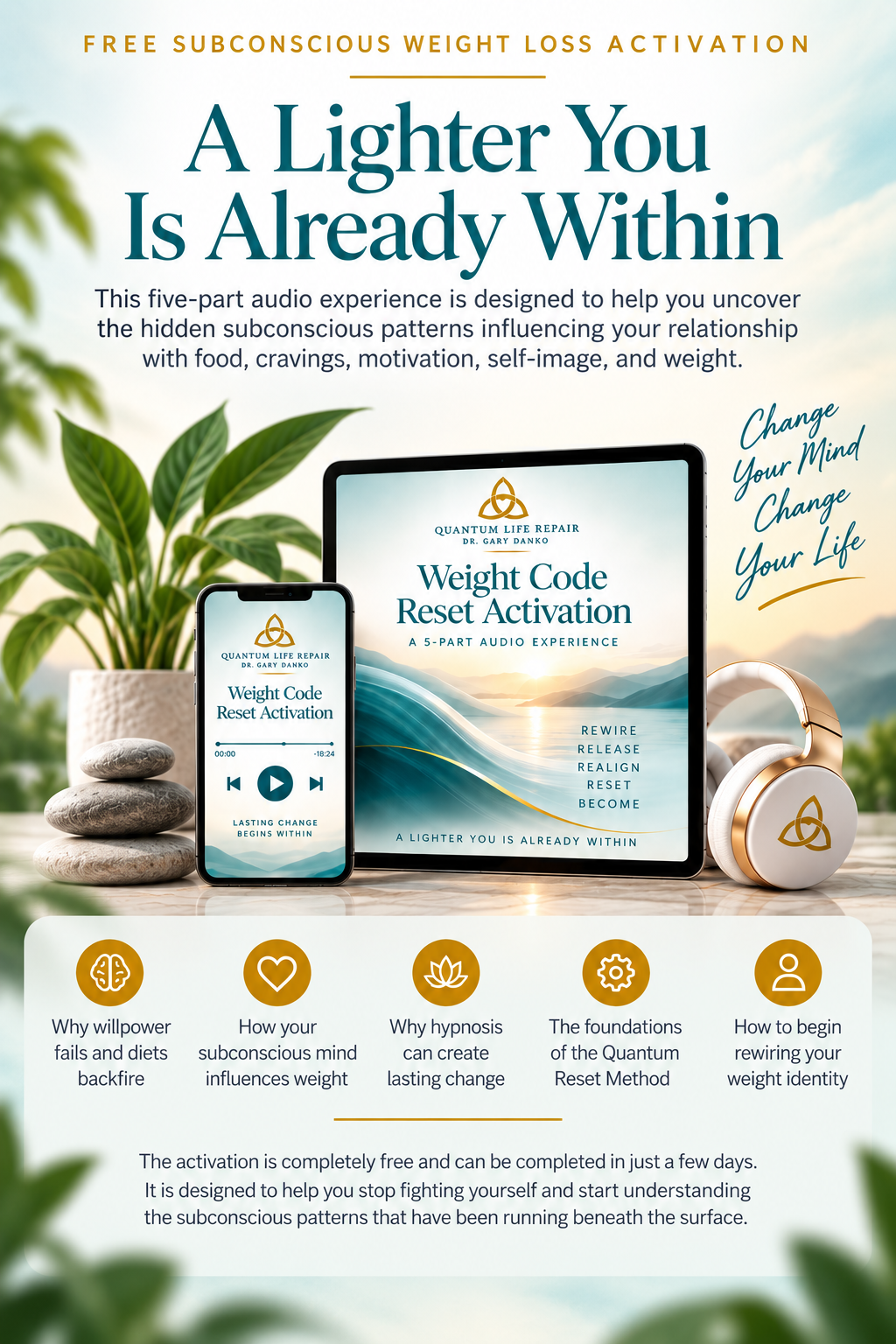
Ready for Deeper Transformation?
DEEPER TRANSFORMATION
If you’re ready to move beyond understanding the patterns and begin changing them at a deeper level, the Quantum Reset Weight Release Program provides a comprehensive subconscious transformation process designed to address the patterns behind your relationship with food, weight, habits, and self-image.
The program includes specialized hypnosis and subconscious transformation sessions focused on:
The goal is not simply to lose weight.
The goal is to transform the subconscious patterns that caused the struggle in the first place.
Explore the Weight Loss Resource Library
Continue exploring the subconscious patterns behind weight, cravings, emotional eating, motivation, stress, and lasting change.
Frequently Asked Questions
Subconscious weight loss focuses on changing the hidden emotional, mental, behavioral, and identity-based patterns that influence eating habits, cravings, self-image, motivation, and long-term consistency.
Many diets focus only on conscious behavior while leaving subconscious habits, emotional triggers, identity patterns, and self-sabotage mechanisms unchanged.
Many people use hypnosis to support healthier eating habits, reduce cravings, strengthen motivation, improve consistency, and address emotional eating patterns.
Self-sabotage often occurs when subconscious beliefs, emotional patterns, or identity conflicts oppose your conscious weight-loss goals.
The Quantum Reset Method is a subconscious weight loss framework designed to help transform the deeper patterns that contribute to emotional eating, cravings, low motivation, and weight-loss resistance.
The best place to begin is the free Weight Code Reset Activation, which introduces the foundational principles of subconscious weight loss and the Quantum Reset Method.
Final Thoughts
Lasting weight loss is rarely about forcing yourself to work harder.
More often, it comes from understanding the subconscious patterns that influence your habits, emotions, beliefs, identity, and relationship with food.
As these deeper patterns begin to change, healthy choices often feel more natural, motivation becomes more sustainable, and progress feels less like a constant battle.
You stop relying exclusively on willpower and begin creating alignment between your conscious goals and your subconscious programming.
If you are ready to begin transforming your relationship with weight from the inside out, start with the Free Weight Code Reset Activation.
And when you are ready for deeper transformation, explore the Quantum Reset Weight Release Program.
About Dr. Gary Danko

Dr. Gary Danko is the founder of Quantum Life Repair and creator of the Quantum Reset Method. His work integrates hypnosis, subconscious reprogramming, cognitive behavioral techniques, energy healing, and mind-body transformation to help people identify and change the deeper emotional, behavioral, and identity-based patterns that can keep them stuck. His approach focuses on creating lasting change from the inside out rather than simply managing unwanted behaviors.