
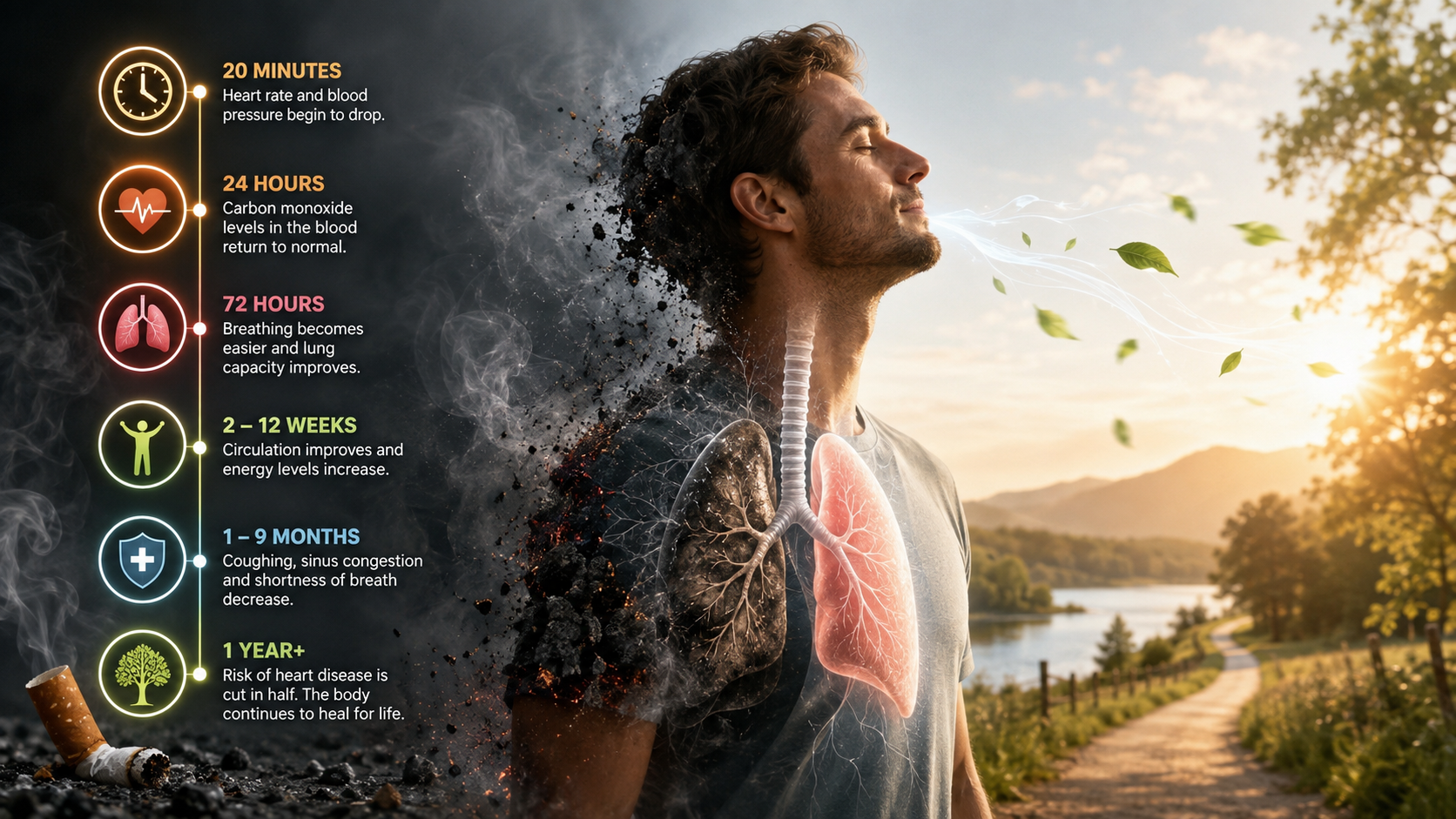
Many smokers know that quitting is good for their health, but few realize how quickly the body begins repairing itself after the last cigarette.
Within minutes of quitting smoking, positive changes begin taking place throughout the body. Over the following days, weeks, months, and years, the risk of smoking-related diseases continues to decline while physical and mental health gradually improve.
Understanding the benefits of quitting smoking can provide powerful motivation during difficult moments. Every craving resisted and every smoke-free day allows the body another opportunity to heal.
Want the complete roadmap to becoming a non-smoker? Start with our Subconscious Quit Smoking Guide to learn how cravings, triggers, hypnosis, relapse prevention, and behavioral change work together to create lasting freedom from smoking.
Table of Contents
- How Quickly Does the Body Recover After Quitting Smoking?
- The Mental Benefits Often Begin Earlier Than Expected
- The Social and Emotional Benefits of Quitting Smoking
- Recovery Is Not Always Linear
- Frequently Asked Questions About the Benefits of Quitting Smoking
- Ready to Experience the Benefits of Becoming Smoke-Free?
- Related Reading
- Medical References
How Quickly Does the Body Recover After Quitting Smoking?
The body begins healing almost immediately after smoking stops. While some benefits occur within minutes, others continue developing over months and years.
The timeline below highlights many of the most significant improvements former smokers experience after quitting.
20 Minutes After Quitting Smoking
Within just 20 minutes of your last cigarette, heart rate and blood pressure begin moving toward healthier levels.
This is one of the first signs that the body is no longer being exposed to nicotine and other chemicals found in cigarette smoke.
8 Hours After Quitting Smoking
Carbon monoxide levels in the bloodstream begin falling while oxygen levels rise.
This allows oxygen to move more efficiently throughout the body, helping tissues and organs function more effectively.
24 Hours After Quitting Smoking
The risk of a heart attack begins decreasing as carbon monoxide continues leaving the body.
Although cravings may still be present, important cardiovascular improvements are already underway.
48 Hours After Quitting Smoking
After approximately two days without cigarettes, the body has eliminated most remaining nicotine.
Many smokers notice that their senses of taste and smell begin improving during this stage. Foods often taste richer, and everyday scents become more noticeable.
While this can make meals more enjoyable, it may also contribute to increased appetite, which is one reason some people experience temporary weight gain after quitting smoking.
72 Hours After Quitting Smoking
For many people, the first three days represent the most challenging period of nicotine withdrawal.
Cravings often peak during this stage, and symptoms such as irritability, anxiety, restlessness, and difficulty concentrating may be most noticeable.
The encouraging news is that these symptoms are signs that the body is adapting to life without nicotine.
If you are currently experiencing these challenges, our Nicotine Withdrawal Timeline Guide explains exactly what to expect during this phase.
Important: Many smokers mistake temporary withdrawal symptoms for permanent suffering. In reality, the most intense physical withdrawal symptoms typically improve significantly within the first few weeks.
2 Weeks to 3 Months After Quitting Smoking
This period is often when smokers begin noticing some of the most rewarding physical improvements.
- Circulation improves.
- Lung function begins increasing.
- Walking and exercise often feel easier.
- Breathing becomes less labored.
- Coughing and shortness of breath may decrease.
- Energy levels often improve.
Many former smokers report feeling healthier and more physically capable during this stage.
This is also the period when many cravings shift from physical withdrawal to learned behavioral patterns and smoking triggers.
3 to 9 Months After Quitting Smoking
As the lungs continue recovering, many respiratory symptoms begin improving.
- Less coughing
- Reduced congestion
- Improved breathing capacity
- Better stamina
- Fewer respiratory infections
The tiny hair-like structures in the lungs known as cilia begin functioning more effectively. These structures help remove mucus, debris, and harmful particles from the respiratory system.
This ongoing recovery process helps improve lung health and reduces susceptibility to illness.
The Mental Benefits Often Begin Earlier Than Expected
While many people focus on the physical benefits of quitting smoking, the mental and emotional improvements can be just as meaningful.
Former smokers frequently report:
- Greater confidence
- Improved self-esteem
- Reduced guilt about smoking
- A sense of personal accomplishment
- Increased feelings of control
- Greater optimism about the future
These psychological benefits often begin developing long before the major long-term health improvements become visible.
1 Year After Quitting Smoking
One year after quitting smoking, one of the most important health milestones occurs.
The risk of coronary heart disease drops dramatically compared to someone who continues smoking. The heart and blood vessels have had an entire year to recover from the constant strain caused by nicotine, carbon monoxide, and thousands of harmful chemicals found in cigarette smoke.
For many former smokers, this is also the point where being smoke-free begins feeling more natural and less like a daily struggle.
5 Years After Quitting Smoking
Five years after quitting, the body continues making remarkable progress.
- Stroke risk may approach that of a non-smoker.
- Blood vessel function improves significantly.
- Circulation continues recovering.
- Cardiovascular health becomes substantially stronger.
Many people underestimate how much healing continues taking place years after the last cigarette.
10 Years After Quitting Smoking
A decade after quitting smoking, the risk of lung cancer is significantly lower than for individuals who continue smoking.
In addition, the risks of cancers affecting the mouth, throat, esophagus, bladder, pancreas, and other organs continue declining.
While some damage from long-term smoking may not be completely reversible, the body’s ability to heal and reduce future risk is remarkable.
15 Years After Quitting Smoking
Fifteen years after quitting, the risk of heart disease may become similar to that of someone who has never smoked.
This milestone highlights an important truth:
It is never too late to quit smoking.
Whether you smoked for five years or fifty years, the body begins benefiting the moment smoking stops.
The sooner you quit, the greater the potential benefits—but meaningful improvements occur at every age and every stage of the quitting journey.
The Financial Benefits of Quitting Smoking
Health improvements are often the primary reason people quit smoking, but the financial benefits can be substantial as well.
Consider a smoker who spends $10 per day on cigarettes:
- $70 per week
- $300+ per month
- More than $3,600 per year
- More than $36,000 over 10 years
For many former smokers, quitting creates opportunities to redirect money toward travel, hobbies, family experiences, savings, or other meaningful goals.
The Social and Emotional Benefits of Quitting Smoking
The rewards of becoming smoke-free extend beyond physical health.
Former smokers frequently report:
- Greater confidence
- Improved self-image
- Less anxiety about future health problems
- Freedom from planning life around cigarettes
- More enjoyment of social situations
- A stronger sense of control over their lives
Many people describe quitting smoking as one of the most empowering decisions they have ever made.
Recovery Is Not Always Linear
It is important to remember that recovery does not happen in a perfectly straight line.
Some days may feel easier than others. Cravings may occasionally return. Old habits and smoking triggers can reappear unexpectedly.
This does not mean you are failing.
It simply means your brain is continuing to adapt to a new identity as a non-smoker.
If you are struggling with cravings, be sure to read our guides on Smoking Triggers and How to Avoid Smoking Relapse.
Frequently Asked Questions About the Benefits of Quitting Smoking
The body begins healing within minutes of the last cigarette. Heart rate and blood pressure start improving within 20 minutes, and oxygen levels begin recovering within hours.
For most people, nicotine withdrawal symptoms peak within the first 2–3 days and improve significantly over the following weeks. However, smoking triggers and habit-related cravings may continue appearing for longer periods.
The lungs can begin repairing themselves after smoking stops. While some damage may be permanent, lung function often improves, coughing decreases, and respiratory health can continue recovering for years.
Absolutely. Regardless of age or smoking history, quitting smoking can reduce health risks and improve quality of life. The body begins benefiting almost immediately after smoking stops.
Some people experience modest weight gain after quitting, while others maintain or even lose weight. Understanding healthy coping strategies can help minimize unwanted weight gain. Learn more in our guide on Weight Gain After Quitting Smoking.
Many people use hypnosis as part of their quit-smoking strategy. Hypnosis may help address subconscious habits, emotional triggers, and automatic smoking behaviors that often contribute to relapse.
Ready to Experience the Benefits of Becoming Smoke-Free?
Every cigarette you don’t smoke gives your body another opportunity to heal.
The challenge is not simply understanding the benefits of quitting. The challenge is breaking the subconscious habits, emotional triggers, and routines that keep smoking in place.
Our free quit smoking program combines hypnosis, behavioral change strategies, and subconscious reconditioning to help you create lasting freedom from smoking.
🎧 Start the Free Quit Smoking Program →
Related Reading
- Subconscious Quit Smoking: The Complete Guide
- Nicotine Withdrawal Timeline: What to Expect When You Quit Smoking
- Smoking Triggers: Why You Crave Cigarettes and How to Break the Habit
- Weight Gain After Quitting Smoking: Causes, Prevention, and What to Expect
- How to Avoid Smoking Relapse
- Long-Term Effects of Smoking on Your Body and Brain
- Hypnosis: A Smoking Cessation Tool?
Medical References
- Centers for Disease Control and Prevention (CDC)
- Smokefree.gov
- National Cancer Institute
- American Lung Association
- National Institutes of Health (NIH)
- World Health Organization (WHO)
Reviewed by Dr. Gary Danko
Dr. Gary Danko specializes in helping individuals overcome smoking dependence through hypnosis, subconscious reconditioning, behavioral change strategies, and wellness-focused coaching. His work focuses on helping smokers create lasting freedom rather than relying solely on willpower.
Add your first comment to this post