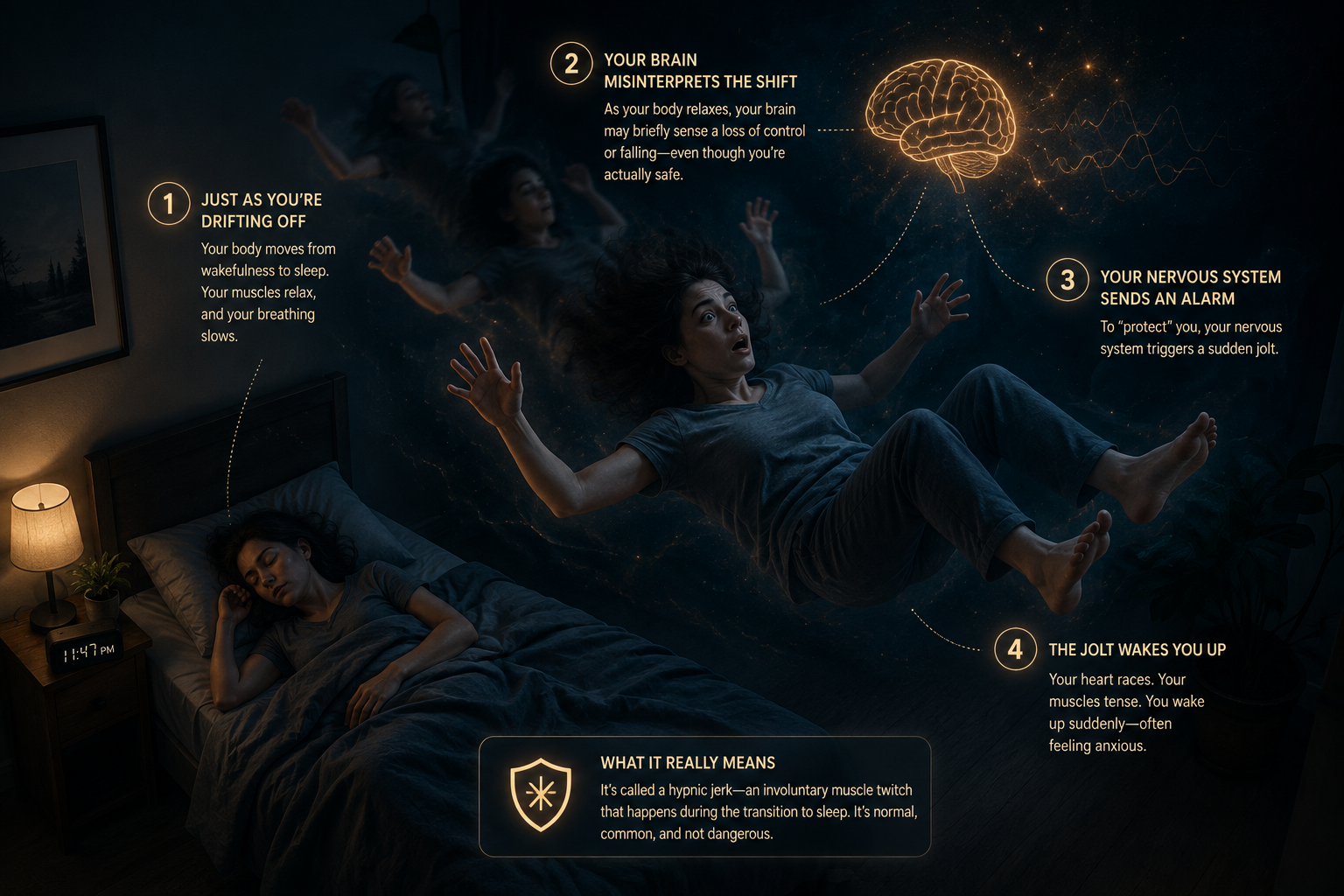
Why Does It Feel Like I’m Falling When I Try to Sleep? (And Why It Wakes You Up)

You’re just about to fall asleep.

Your body is relaxed. Your mind is drifting. You feel yourself slipping into that quiet space between awake and asleep…

And then suddenly—

It feels like you’re falling.

Your body drops. Your chest tightens. You jolt awake.

Your heart starts racing, and for a moment, it can feel intense—almost like something went wrong.

If you’ve experienced this falling sensation when trying to sleep, you’re not alone.

And more importantly, this is not a sign that something is wrong with you.

If this is happening to you at night, you don’t need more information — you need something that helps your body settle in the moment.

I created a free 5-minute emergency sleep reset you can use when your body feels wired, panicky, or unable to shut off.

👉 Start the free reset here:
Free 5-Minute Emergency Sleep Reset

Read More

How to Calm Your Nervous System Before Sleep (So Your Body Can Finally Rest)

You finally lie down after a long day. Your body is exhausted. Your eyes are heavy. And yet… something inside you won’t let go.

Your chest feels tight. Your muscles stay braced. Your mind may not even be racing, but your body feels alert, wired, or tense — as if sleep is just out of reach. If this sounds familiar, you’re not broken, and you’re not failing at sleep.

This often reflects an overactive nervous system at night rather than a true inability to sleep.

Some people experience this as bedtime anxiety, nighttime hypervigilance, adrenaline surges, or the frustrating feeling of being “tired but wired.”

Learning how to calm your nervous system before sleep is often the missing piece. Because for many people, nighttime wakefulness isn’t about thoughts or willpower — it’s about a nervous system that hasn’t yet received the signal that it’s safe to rest.

Calming the nervous system before sleep involves reducing internal threat signals and increasing cues of safety, predictability, and physical reassurance.

If this is happening to you at night, you don’t need more information — you need something that helps your body settle in the moment.

I created a free 5-minute emergency sleep reset you can use when your body feels wired, panicky, or unable to shut off.

👉 Start the free reset here:
Free 5-Minute Emergency Sleep Reset

Read More

EFT Tapping for Physical Anxiety Symptoms

Woman meditating with hand on chest, with calming health and heart-rate illustrations around her

For many people, anxiety doesn’t begin with racing thoughts. It begins in the body.

A tight chest. A fluttering heart. Shallow breathing. A knot in the stomach. Muscles that won’t unclench. Sometimes the body reacts long before the mind can explain why.

If this is how anxiety shows up for you, you’re not imagining it—and you’re not broken. Physical anxiety symptoms are a common expression of a nervous system that learned to stay alert for a reason. EFT tapping for physical anxiety symptoms works precisely because it speaks the language the body understands.

New to EFT? This article focuses specifically on physical anxiety symptoms. For the full overview of Emotional Freedom Technique, start with the main guide:

👉 EFT Tapping: The Complete Guide to Emotional Freedom Technique

Read More

EFT Tapping for Anxiety Before Bed

Woman sitting in bed with eyes closed, touching her face and chest in a calm nighttime scene

As bedtime approaches, many people notice a familiar shift. The lights dim, the world gets quieter—and instead of feeling sleepy, anxiety begins to rise. Thoughts speed up, the body feels tense, and rest suddenly feels out of reach.

If this happens to you, it doesn’t mean you’re doing anything wrong. More often, it means your nervous system is finally noticing what it’s been carrying all day. Anxiety before bed is not a failure of relaxation—it’s a signal that your system is looking for safety.

EFT tapping for anxiety before bed offers a gentle way to meet that signal without force, effort, or pressure. It works with the body’s natural calming pathways, helping the nervous system soften as sleep approaches.

Looking for the complete EFT guide?

This article focuses specifically on bedtime anxiety and sleep-related nervous system activation. For a complete overview of EFT tapping, benefits, research, anxiety relief, sleep support, and emotional healing, start here:

👉 EFT Tapping: The Complete Guide to Emotional Freedom Technique

Read More

EFT Tapping for Nighttime Anxiety: How to Calm the Mind Before Bed

Woman lying awake in bed, looking worried as swirling thoughts fill the dark bedroom night sky

She lay in the dark, staring at the ceiling, knowing exactly what was coming next. Her chest tightened first — a subtle pressure under her sternum — followed by the familiar buzzing in her mind, the mental unraveling she couldn’t stop. Thoughts she had distracted herself from all day suddenly surged forward like rushing water. That sinking feeling arrived: EFT tapping for nighttime anxiety sounded helpful, but right now she wasn’t sure anything could quiet the storm rising inside her.

She shifted positions, pulled the blanket closer, took a slow inhale, and tried to convince her body that everything was fine. But her nervous system wasn’t listening. The worry loops intensified — What if I don’t sleep again? What if tomorrow is ruined? Why is my mind so loud right now? She knew she needed relief, something she could access instantly, something that could slow her heart and soften the pressure in her chest. But willpower wasn’t working. Distraction wasn’t working. Nothing familiar was working.

What she didn’t know yet is that nighttime anxiety follows a predictable pattern — one rooted in subconscious processing, hormonal rhythms, emotional residue, and a nervous system that hasn’t fully powered down. And that EFT tapping offers a uniquely effective way to interrupt these loops, calm the limbic system, reduce physical tension, and guide the mind back toward rest.

New to EFT?

This article focuses specifically on nighttime anxiety, waking up anxious, and sleep-related stress patterns.

For a complete overview of Emotional Freedom Technique, tapping points, anxiety relief, research, and beginner instructions, start here:

👉 EFT Tapping: Complete Beginner’s Guide

Read More

Why Stress Gets Trapped in Your Body — And How EFT Tapping Releases It Fast

Woman sitting in a car with eyes closed, holding the steering wheel, surrounded by glowing energy swirls

She sat in her car with the engine off, hands still gripping the steering wheel.

The meeting was over. The pressure had passed. Nothing bad was happening anymore. But her body had not gotten the message.

Her chest felt tight. Her stomach churned. Her throat felt locked. It was as if the stress had taken physical form and was still clinging to her from the inside.

She whispered to herself, “Why does this stay in me? Why can’t I let it go?”

This is the moment many people begin searching for answers. They can feel stress stuck in the body — in the muscles, breath, chest, stomach, jaw, shoulders, or nervous system — even after the stressful moment has already ended.

Stress stuck in the body EFT refers to using Emotional Freedom Technique tapping to help release stored emotional tension, calm the nervous system, and give the body a direct signal that it is safe to soften.

This article explains why stress can feel physically trapped, how EFT tapping may help release it, and a simple tapping sequence you can try when your body feels tense, heavy, frozen, or overwhelmed.

If you’re new to Emotional Freedom Technique, start with the EFT Tapping Hub where you’ll find beginner guides, tapping points, anxiety relief techniques, scientific research, and additional EFT resources.

Read More

Why “One Last Cigarette” Feels Impossible to Resist — And How to Break the Subconscious Relapse Loop

A man in a dark hoodie reaches toward a cigarette pack on a table, with smoke swirling around him

He stood just outside the back door, staring at the old familiar pack sitting on the patio table. It wasn’t even supposed to be there. He’d thrown his last pack away a week ago. He’d told everyone he was done. He’d listened to hypnosis, read articles, made a plan.

But tonight, after a long day, an argument he didn’t see coming, and that creeping sense of “too much” pressing into his chest, there it was again. One cigarette. One lighter. One moment.

His mind started whispering the same lines it always did right before a relapse:

  • “It’s just one last cigarette.”
  • “You’ve done so well; you deserve a break.”
  • “You’ll quit again tomorrow.”
  • “You need this right now. Just to calm down.”

His heart pounded. His jaw clenched. His hand hovered just inches from the pack.

He wasn’t choosing calmly. He was being pulled.

Logically, he knew the truth. There’s no such thing as “one last cigarette.” It always became a few more… then a pack… then a full-blown return to smoking. He’d lived this loop so many times that he could predict the regret before it even happened.

And yet, in that exact moment — the moment that matters most — logic lost every time.

If you’ve ever been there, frozen in that thin slice of time between “I’m done smoking” and “I’m lighting up again,” this article is for you. Because that moment is not about willpower. It’s not about discipline. It’s not about being “weak.”

It’s about a subconscious relapse loop that has been wired into your nervous system, your emotions, and your identity as a smoker… and how you can finally break it with the right tools.

This article is part of the Stop Smoking Naturally resource hub, where you’ll find evidence-based and subconscious-mind approaches for overcoming cravings, preventing relapse, and becoming a permanent non-smoker.

Read More

EFT for Emotional Burnout: When Your System Is Exhausted but You Can’t Stop Pushing — And How Tapping Helps You Reset

Woman crying while gripping a steering wheel in a rain-streaked car at night

She sat alone in her parked car, hands gripping the steering wheel long after the engine stopped. Sophia couldn’t bring herself to walk inside. One more conversation, one more text, one more expectation — it all felt unbearable. But she also knew she wouldn’t stop. She never stopped. She was the one people relied on. The strong one. The capable one.

Inside, she felt like a rubber band stretched past its limit — one unexpected tug away from snapping. From the outside, she looked put together. On the inside, she was collapsing.

Sophia wasn’t unfamiliar with emotional work. She had journaled, meditated, listened to podcasts, taken courses, and tried to “shift her mindset.” She understood burnout logically. But logic wasn’t the issue — her system was depleted. Completely overloaded.

What terrified her most wasn’t the exhaustion. It was the truth she couldn’t admit aloud:

“I don’t know how to stop. I don’t know how to rest. I don’t know how to let go.”

And that’s when the tears came — hot, frustrated, silent. Because it wasn’t weakness that brought her here. It was years of pushing past signals her body had been whispering… then speaking… then screaming.

Emotional burnout isn’t simply “being tired.” It’s the point where your nervous system, subconscious patterns, and energy field have been running in survival mode for so long that “rest” feels unsafe, “slowing down” feels impossible, and “self-care” feels like another thing to perform.

Sophia didn’t need more insight. She needed relief — at the level where the burnout lived.

And EFT tapping was the first method that finally reached it.

If you’re new to EFT or want the full resource path, start with the main guide here: EFT Tapping: The Complete Guide to Emotional Freedom Technique.

Read More

Why You Still Feel Stuck Emotionally Even After Doing All the Inner Work — And How EFT Finally Releases What the Mind Can’t Reach

Woman meditating indoors with one hand on her chest and one on her face, in a calm, sunlit room

You’ve read the books. You’ve journaled until your hand cramped. You’ve meditated, visualized, affirmed, healed your inner child, and tried to “shift your mindset.” And yet — despite all that work — a familiar emotional heaviness still follows you into every new chapter of your life.

You’re wiser now, more self-aware, more intentional… and somehow still carrying patterns that should have dissolved years ago. You tell yourself you’ve made progress (because you have), but a deeper truth lingers beneath the surface:

“I know better. So why do I still feel this way?”

This article explores the real reason you remain stuck — even after extraordinary inner work — and how EFT Tapping reaches the layers that your conscious mind simply cannot touch.

If you’re new to EFT, start with our complete guide to Emotional Freedom Technique (EFT Tapping) to understand how this powerful method helps release emotional patterns stored in the body and subconscious mind.

By the end, you’ll understand exactly why emotional patterns survive logic, insight, and even years of personal growth… and how EFT finally releases what the mind alone cannot.

Read More

EFT Tapping for Anxiety Relief: Calm Your Mind Fast

By Dr. Gary Danko

When your thoughts are racing and your body is on high alert, it can feel like there’s no way to switch off the inner alarm. EFT tapping for anxiety relief gives you a simple, practical way to calm your nervous system, release emotional tension, and regain a sense of control in just a few minutes — using only your fingertips and your focused awareness.

Whether you’ve been dealing with anxiety for years or you’re just going through a rough patch, Emotional Freedom Technique (EFT) can help you interrupt spiraling thoughts, release stored stress in the body, and gently retrain your subconscious response to triggers. In this article, you’ll learn how EFT works, why it’s so effective for anxiety, and how to start using it today to create more peace in your mind and body.

Read More