
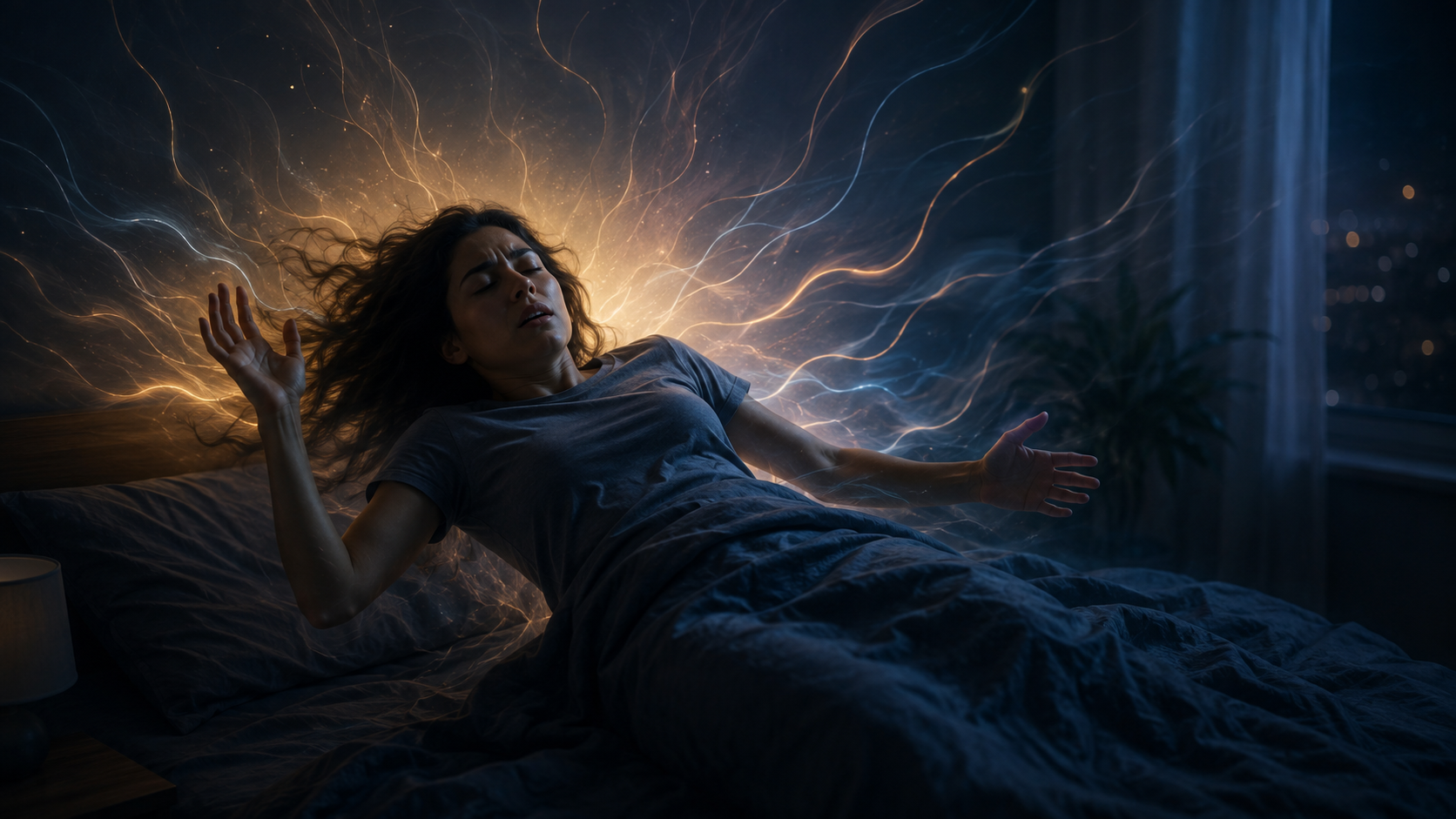
If your body suddenly jerks, twitches, or shocks awake just as you’re falling asleep, you’re not alone. These nighttime body jolts are commonly linked to hypnic jerks and anxiety. While they can feel intense or frightening, they’re usually harmless and connected to how the nervous system transitions into sleep.
This article is for educational purposes only and does not diagnose or treat medical conditions. If symptoms are severe, persistent, or accompanied by other concerning changes, consult a licensed healthcare professional.
You’re finally starting to fall asleep.
Your body softens. Your thoughts begin to fade. There’s that familiar moment where you feel yourself drifting.
And then—suddenly—your body jolts.
A leg kicks. Your chest jumps. Your whole body might twitch or jerk like you were startled awake.
Sometimes it feels like a shock. Sometimes like you were falling. Sometimes like your body just “woke itself up” for no reason.
Your heart might start racing. A quick wave of adrenaline might follow.
And just like that… you’re awake again.
If this has been happening to you, it’s completely understandable that you’d feel confused—or even concerned.
But here’s the most important thing to understand right away:
Body jolts when falling asleep with anxiety are very common—and they are not dangerous.
This is not your body malfunctioning.
This is your nervous system reacting during the transition into sleep.
And once you understand why it happens, the experience becomes far less unsettling.
If this is happening to you at night, you don’t need more information — you need something that helps your body settle in the moment.
I created a free 5-minute emergency sleep reset you can use when your body feels wired, panicky, or unable to shut off.
👉 Start the free reset here:
Free 5-Minute Emergency Sleep Reset
Table of Contents
- What Body Jolts When Falling Asleep Feel Like
- Why Your Body Jolts When Falling Asleep
- Why Anxiety Makes Body Jolts Worse at Night
- Why It Happens Right at Sleep Onset
- Why It Feels Scary (Even When It’s Not Dangerous)
- Why Body Jolts Keep Happening Every Night
- Why Trying to Stop It Makes It Worse
- How to Reduce Body Jolts Naturally
- When the Body Starts to Settle Again
- If This Keeps Happening…
- Can Anxiety Cause Hypnic Jerks?
- Frequently Asked Questions
- Related Sleep Anxiety Symptoms
- About Dr. Gary Danko
What Body Jolts When Falling Asleep Feel Like
People describe these sensations in different ways, but they all point to the same experience.
You may feel:
A sudden body jerk or twitch as you drift off
A quick “shock” or jolt through your body
A feeling like you’re falling or dropping
A sudden wake-up just as you were about to sleep
A burst of adrenaline immediately after the jolt
These are often referred to as hypnic jerks.
They happen during the early stage of sleep, when your body is shifting from being awake to being asleep.
When anxiety is involved, these sensations can feel stronger, more frequent, and more noticeable.
This is why many people search for things like:
“body jolts when falling asleep anxiety”
Because it doesn’t feel random—it feels connected to how your body is responding at night.
Why Your Body Jolts When Falling Asleep
To understand this, you need to understand what your body is doing when you fall asleep.
Sleep is not instant.
It’s a gradual transition.
As you drift off:
Your muscles relax
Your breathing slows
Your brain shifts into a different rhythm
During this process, your brain is still monitoring your body.
Sometimes, it misinterprets the relaxation as a loss of balance or control.
When that happens, it sends a quick signal to your muscles.
The result?
A sudden jerk.
This is the sleep start reflex.
And it happens to a large percentage of people.
On its own, it’s completely normal.
But when the nervous system is more sensitive—like in anxiety—it becomes more noticeable and more frequent.
Why Anxiety Makes Body Jolts Worse at Night
Anxiety changes how your nervous system operates.
Instead of fully relaxing at night, your system may stay partially alert.
This is often called hyperarousal.
In this state:
Your brain is scanning for threat
Your body is ready to respond
Your system is not fully willing to let go
So when you begin to fall asleep, your body hesitates.
And that hesitation can show up as a jolt.
This is why people dealing with sleep twitch anxiety or jerking awake when falling asleep anxiety often notice the pattern more at night than during the day.
It’s not that something is wrong.
It’s that your nervous system is still “on.”
You may also notice other symptoms happening alongside it, such as adrenaline rush when falling asleep or heart racing when trying to fall asleep.
These are all part of the same underlying pattern.
Why It Happens Right at Sleep Onset
The timing of these jolts is not random.
They happen right as you fall asleep because that’s when your body is transitioning out of control.
During the day, your brain is actively managing your environment.
At night, that control begins to fade.
Your system shifts into a more automatic state.
For a calm nervous system, this feels natural.
For an alert nervous system, this can feel uncertain.
And uncertainty triggers protection.
So your body interrupts the process.
The jolt is not an error.
It’s a reflex.
A brief “check” to make sure everything is okay.
This is also why some people experience panic when falling asleep in the same moment.
Why It Feels Scary (Even When It’s Not Dangerous)
The sensation itself is not harmful.
But it feels intense.
And intensity triggers interpretation.
Your brain tries to make sense of what just happened.
And often, it jumps to the worst-case scenario.
But the truth is much simpler.
Your body had a brief reflex during a vulnerable moment.
That’s it.
The reason it feels scary is because:
It’s sudden
It happens when you’re relaxed
It interrupts sleep
And your brain isn’t expecting it.
Once you understand that it’s a normal response, the fear around it starts to decrease.
Why Body Jolts Keep Happening Every Night
For many people, this doesn’t just happen once.
It becomes a pattern.
Here’s how that pattern develops:
You experience a jolt
It feels intense
Your brain marks it as important
The next night, you’re slightly more aware.
You’re paying attention.
Your body picks up on that awareness.
And it responds.
Over time, this creates a loop:
Sleep → awareness → jolt → alertness
This is not conscious.
It’s conditioning.
And conditioned patterns can be changed.
If you want a broader understanding of how these symptoms connect, you can explore sleep anxiety symptoms in more detail.
Why Trying to Stop It Makes It Worse
This is where most people get stuck.
You feel the jolt coming—or you remember it from the night before—and you try to prevent it.
You monitor your body.
You try to relax harder.
You try to control your breathing.
But control signals the nervous system that something is wrong.
And when something feels wrong, the body stays alert.
This is the paradox:
The more you try to stop the jolts, the more your body prepares for them.
Because it thinks they matter.
And attention reinforces patterns.
How to Reduce Body Jolts Naturally
The goal is not to eliminate the sensation instantly.
The goal is to change how your body responds to it.
This includes:
Allowing the Sensation
Notice the jolt without reacting to it as a threat.
Reducing Resistance
The less you fight it, the less your nervous system escalates.
Creating Consistent Safety Signals
Calm, predictable routines help your body feel secure at night.
Letting the Body Settle Naturally
Sleep happens when the system is ready—not when it’s forced.
These changes are subtle, but they are powerful over time.
When the Body Starts to Settle Again
At first, you may still experience the jolts.
But they feel less intense.
They pass more quickly.
You don’t react as strongly.
And gradually, something deeper shifts.
Your nervous system begins to trust the transition into sleep again.
The jolts become less frequent.
The night feels quieter.
And sleep becomes easier.
Not because you forced it.
But because your body no longer feels the need to interrupt it.
If This Keeps Happening…
If you’re experiencing repeated body jolts when falling asleep with anxiety, it usually means your nervous system has learned a pattern of staying alert.
And that pattern can change.
If this is happening to you at night, you don’t need more information — you need something that helps your body settle in the moment.
I created a free 5-minute emergency sleep reset you can use when your body feels wired, panicky, or unable to shut off.
👉 Start the free reset here:
Free 5-Minute Emergency Sleep Reset
Can Anxiety Cause Hypnic Jerks?
Yes. Anxiety can make hypnic jerks more frequent and more noticeable.
When the nervous system stays in a heightened state of alertness, the body may react more strongly during the transition into sleep. This can lead to sudden muscle jerks, adrenaline surges, or waking sensations right as you begin falling asleep.
Anxiety does not usually create danger during sleep onset — but it can make normal sleep reflexes feel more intense.
Frequently Asked Questions
This usually happens because your brain briefly misinterprets muscle relaxation during sleep onset. It sends a quick signal to your muscles, causing a sudden jerk.
Anxiety doesn’t cause hypnic jerks directly, but it makes them more frequent and noticeable by keeping the nervous system in a heightened state of alertness.
No. In most cases, they are harmless and simply part of the body’s transition into sleep.
The suddenness of the muscle contraction combined with nervous system activation can feel like a shock or surge.
Focus on calming the nervous system rather than stopping the sensation. Reducing resistance and allowing the experience can help decrease frequency over time.
Yes. Stress keeps the nervous system activated, which increases the likelihood of nighttime muscle jerks.
This often happens because the nervous system has learned a pattern. Repetition reinforces the experience, but it can also be retrained.
Yes. As your nervous system becomes calmer and feels safe at night, these symptoms often decrease significantly.
Related Sleep Anxiety Symptoms
Body jolts when falling asleep often happen alongside other sleep anxiety symptoms. These experiences can feel different, but they usually come from the same pattern: a nervous system that stays partially alert when your body is trying to fall asleep.
You may also relate to:
- Adrenaline rush when falling asleep
- Panic when falling asleep
- Heart racing when trying to fall asleep
- Falling sensation when trying to sleep
- Sleep anxiety symptoms
For the full step-by-step guide to calming this pattern at night, start here:
About Dr. Gary Danko
Dr. Gary Danko writes about anxiety, nervous system regulation, sleep-related stress, subconscious healing, and emotional wellness. His work focuses on helping people better understand how the mind and body respond to chronic stress and anxiety patterns.
Add your first comment to this post